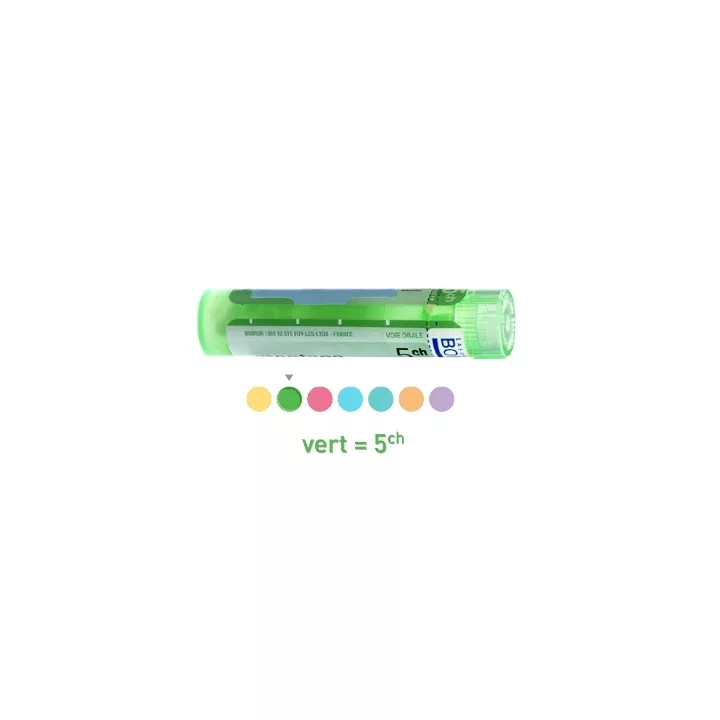
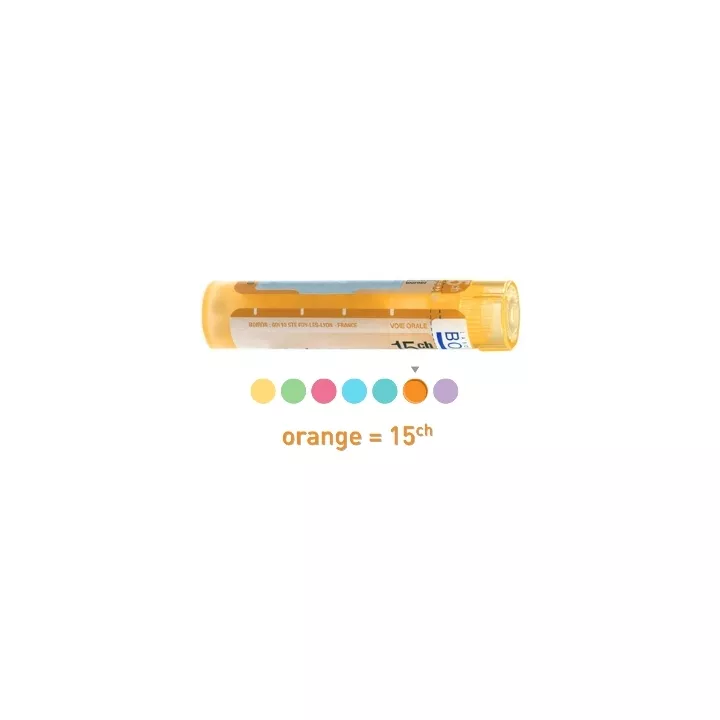
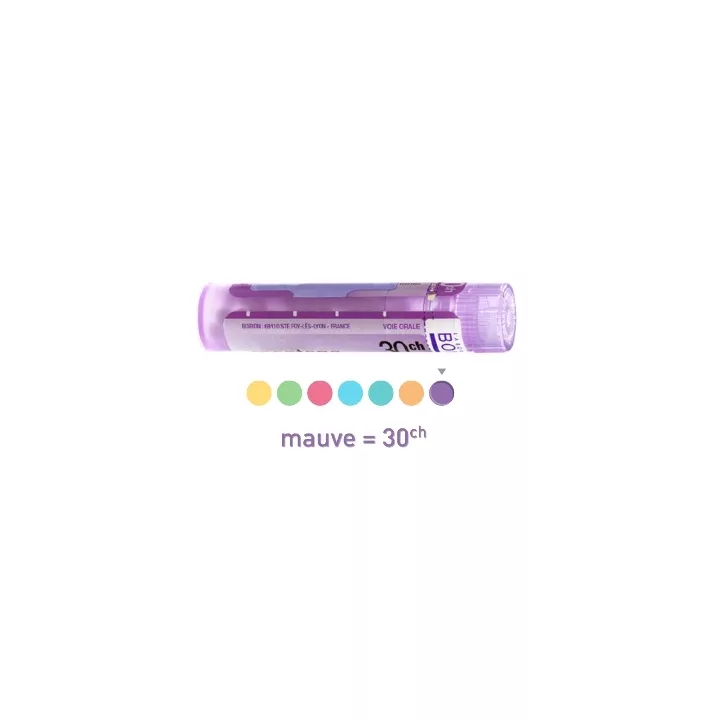
Carbo Végétabilis 4CH, 5CH, 7CH, 9CH, 12CH, 15CH, 30CH Homeopathic Granules by Boiron
Registered medication: EH00434
French Name: CHARBON VEGETAL OFFICINAL
Origin: Plant-based
Carbo Vegetabilis is a homeopathic remedy used to treat certain symptoms of gastroenteritis. It also acts as an antiseptic when prescribed to treat bedsores and skin conditions. In pulmonology, it is frequently combined with allopathic vasodilator therapy to help patients breathe more easily. In cardiology, it promotes blood purification to prevent cyanosis.
Indications and Dosage
Homeopathic medications—whether in granule tubes or globule doses—can be used for a variety of symptoms; therefore, it is not possible to specify the indications and dosage for a particular preparation.
Recommendations for Cardiac Disorders: Cyanosis is characteristic of poor blood oxygenation, in that the blood contains 5 g of deoxygenated hemoglobin per liter. In this case, the skin exhibits bluish spots resembling bruises on the surface. It may result from a circulatory problem, in which case cyanosis is observed in the extremities, which also become very cold. To gradually restore oxygen balance, it is recommended to take Carbo Vegetabilis.
Respiratory Disorders
Bronchopneumopathy is a condition that can lead to airway obstruction. It primarily affects smokers; however, endogenous or hereditary factors may also cause COPD. In the early stages of the disease, the patient may experience a mild cough, difficulty breathing, and excessive mucus production. Carbo Vegetabilis and Natrum Sulfuricum are among the homeopathic remedies appropriate for treating bronchopneumopathy. In addition, a medical consultation is recommended as soon as the first symptoms of the disease appear.
Homeopathic Remedies for Treating Bronchopneumopathy
Carbo Vegetabilis is a recommended remedy for treating COPD. This homeopathic remedy, made from vegetable charcoal, helps prevent the cough from causing the patient to choke. If a patient is diagnosed with chronic obstructive pulmonary disease (COPD), it is recommended to take a daily dose of 5 granules of Carbo Vegetabilis 7 CH for one week. If the disease is at an advanced stage, such as bronchospasm, Carbo Vegetabilis should be taken in a 15 CH or 30 CH dilution. In addition, Natrum Sulfuricum 15 CH is a homeopathic remedy of mineral origin that is also used to treat bronchopneumopathy. Therefore, it is recommended to take 5 granules of Natrum Sulfuricum 15 CH daily for ten days. On the other hand, to prevent the illness, a person can take a weekly dose of Natrum Sulfuricum 15 CH.
Main Indications for Convalescence
Carbo Vegetabilis is one of the homeopathic remedies prescribed during the convalescence period for patients suffering from a condition that has depleted the body. Carbo Vegetabilis is particularly recommended as a preventive treatment against conditions such as allergies and asthma, which may develop because the body is still too vulnerable during the early days of recovery.
Treatment of Gastroenteritis
Gastroenteritis manifests itself in various ways. But when it is very painful and the patient is in a state of acute fatigue, Carbo Vegetabilis should be used. This form of gastroenteritis is, in most cases, caused by food poisoning.
Similarly, “turista” or traveler’s diarrhea—a digestive disorder similar to gastroenteritis—responds very well to treatment with Carbo Vegetabilis. The condition is characterized by abdominal cramps and pain accompanied by nausea and vomiting caused by poor food hygiene. To treat the condition, take Carbo Vegetabilis 5 CH, but the dosage should be adjusted according to the doctor’s or homeopath’s prescription.
An effective and highly regarded therapeutic approach, homeopathy can cure the symptoms caused byaerogastria. Symptoms such as a heavy feeling in the stomach, the urge to burp, and pain caused by the reflux of stomach acid can disappear entirely thanks to this gentle therapy. For this purpose, homeopaths recommend Carbo vegetalis andArgentum nitricum. In addition, homeopathy offers various substances that reduce stress and prevent the onset of aerogastria. Ignatia and Asa fœtida are effective homeopathic remedies for this purpose. Various other homeopathic remedies can also alleviate the symptoms of this digestive condition and cure it.
The homeopathic physician selects the appropriate remedy, dilution, and dosage based on the patient’s health condition and characteristic symptoms.
Directions for Use
Remove the tab, turn the tube upside down, and pull the cap slightly. Twist the tube to dispense the desired number of granules into the cap, then place the granules under the tongue. It is recommended not to touch the homeopathic granules or globules with your fingers.
Dosage for Laryngitis and Bronchopneumopathy
Carbo Vegetabilis is prescribed for a cough that causes choking, particularly paroxysmal coughs associated with chronic obstructive bronchopneumopathy such as emphysema and asthma. To treat these conditions, it is recommended to take a dose of 5 granules of Carbo Vegetabilis 7CH for one week, in the morning and in the evening.
The same applies in cases of laryngitis causing hoarseness, especially in the evening.
In cases of bronchospasm, Carbo Vegetabilis should be diluted to 15 CH or 30 CH if the condition is at an advanced stage. During an acute episode, it is recommended to begin this homeopathic treatment as soon as possible.
Dosage for Choking Coughs
A simple cough that causes the patient to choke should prompt a consultation with a doctor. In this case, the patient may take Carbo Vegetabilis 15CH at a dose of 5 granules in the morning and a second dose of 5 granules in the evening. If the patient is already undergoing allopathic treatment, they should take a single dose of Carbo Vegetabilis 15CH in the evening.
Dosage for Alcohol Dependence
Certain digestive disorders are caused by the consumption of alcoholic beverages. In such cases, the patient has difficulty digesting food and experiences flatulence. Their face is flushed due to hot flashes in the major blood vessels supplying that area. For this, the patient should take Carbo Vegetabilis 5CH—5 granules one hour before each meal—for two months.
Dosage for Digestive Disorders
Bloating, indigestion, and sluggish digestion are all conditions that affect the digestive system. To address these, take Carbo Vegetabilis, especially when symptoms become recurrent. If bloating occurs after a meal, the recommended dose of Carbo Vegetabilis 5CH is 3 granules to be taken a quarter of an hour before the meal.
For minor difficulties digesting meals, Carbo Vegetabilis 4CH should be combined with Nux Vomica 4CH and Abies Nigra 4CH in the same dilution. To treat this, take 3 granules of each of these homeopathic remedies three times a day to relieve stomach heaviness.
Dosage for Skin Conditions
Varicose hypodermitis, characterized by inflammation of the cellular membranes beneath the skin, is a skin condition caused by poor blood circulation. It is treated with Carbo Vegetabilis. An atonic ulcer—characterized by a skin lesion resulting from poor blood supply that slows healing—can also be treated with Carbo Vegetabilis. To prevent the development of pressure sores, take Carbo Vegetabilis in a 9CH dilution at a dose of 5 granules per day for one month.
The globules from the dose tubes are taken all at once by letting them dissolve slowly under the tongue. If a dose is missed, take 10 globules of the same dilution.
Do not consume astringent substances—such as coffee, tobacco, camphor, mint, or chamomile—within half an hour before taking homeopathic remedies.
Use a mint-free toothpaste (such as Homéodent Boiron, a toothpaste compatible with taking homeopathic granules).
Packaging and Contents
Translucent granule tube (allows you to see the remaining granules). Weight: 4 g. Approximately 80 granules.
Compounded Preparations
- Available in Hahnemannian dilutions starting at 3 CH
- Available in Korsakovian dilutions at 200K, 1,000K, and 10,000K
Precautions for Use
Warning
Contains sucrose. Store homeopathic medicines away from light, heat, moisture, and any sources of fumes or fragrances.
Administering homeopathic granules to infants and children
For granules or alcohol-based drops, dissolve them in 100 ml of water. Since granules take a long time to dissolve, you must prepare your mixture in advance.
Homeopathy and Pregnancy
Homeopathic remedies have no chemical toxicity, no contraindications, no interactions with other medications, and no adverse effects related to the amount ingested. Pregnant women can use homeopathic remedies without any known risk to themselves or their unborn child, but it is best to seek advice.
Frequency of Homeopathic Use
For acute conditions, it is recommended to take homeopathic remedies every hour until symptoms improve. At that point, you should space out the doses to 3 or 4 times a day, then gradually stop.
For chronic conditions, remedies in low dilutions (>9CH) are taken 1 to 2 times a day, while constitutional remedies are taken once a week or even once a month. This decision is up to the homeopath.
What to Do If There Is No Improvement Within 24 Hours
Certain conditions cannot be treated with homeopathy through self-medication alone. Their severity requires medical advice, which can be provided by a homeopathic physician. This physician will determine whether your condition can be treated with homeopathy alone or whether your treatment should be supplemented with allopathic medicine.