NOTICE
ANSM - Last updated: 27/11/2015
Name of the medicinal product
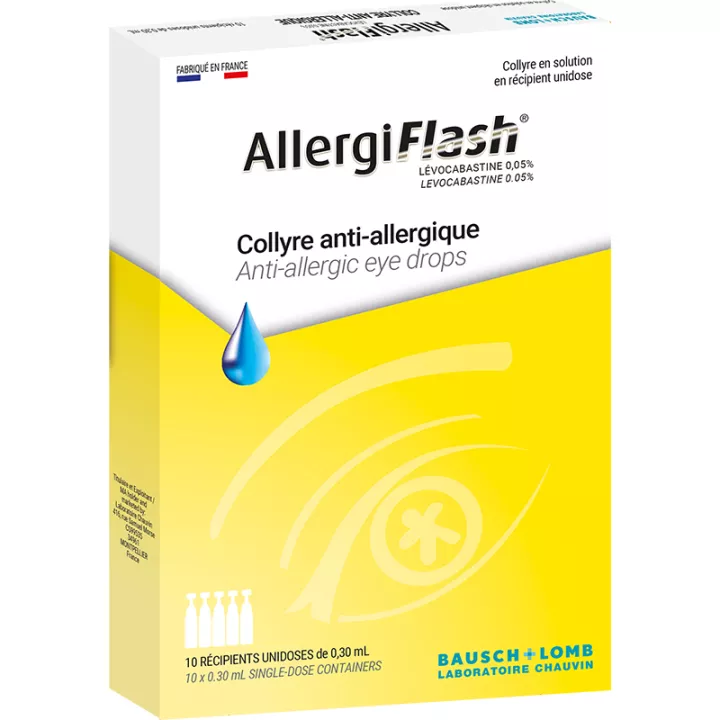
ALLERGIFLASH 0.05%, eye drops in solution in single-dose containers
levocabastine
framed
Read this leaflet carefully before you start using this medicine. It contains important information for your treatment.
· This medication can be used in self-medication, ie used without consultation or prescription from a doctor.
· If symptoms persist, worsen or if new symptoms occur beyond 5 days of treatment, seek the advice of your pharmacist or doctor.
· This leaflet is designed to help you use this medicine. Keep it, you may need to reread it.
DO NOT LEAVE THIS MEDICINE FOR CHILDREN
Review summary
In this notice :
1. WHAT IS ALLERGIFLASH 0.05%, eye drops in solution in single-dose containers AND IN WHAT CASES IS IT USED?
2. BEFORE YOU USE ALLERGIFLASH 0.05%, eye drops in solution in single-dose containers?
3. HOW TO USE ALLERGIFLASH 0.05%, eye drops in solution in a single-dose container?
4. WHAT ARE POSSIBLE SIDE EFFECTS?
5. HOW TO STORE ALLERGIFLASH 0.05%, eye drops in solution in a single-dose container?
6. ADDITIONAL INFORMATION
1. WHAT IS ALLERGIFLASH 0.05%, eye drops in solution in single-dose containers AND IN WHAT CASES IS IT USED?
Pharmacotherapeutic group
Pharmacotherapeutic group: Antihistamine H1 selective - ATC code S01GX02.
ALLERGIFLASH contains an active substance, levocabastine. This substance belongs to the family of medications called antihistamines. These drugs block the release of histamine into the body and thus reduce allergic reactions (histamine plays an important role in allergies).
Therapeutic indications
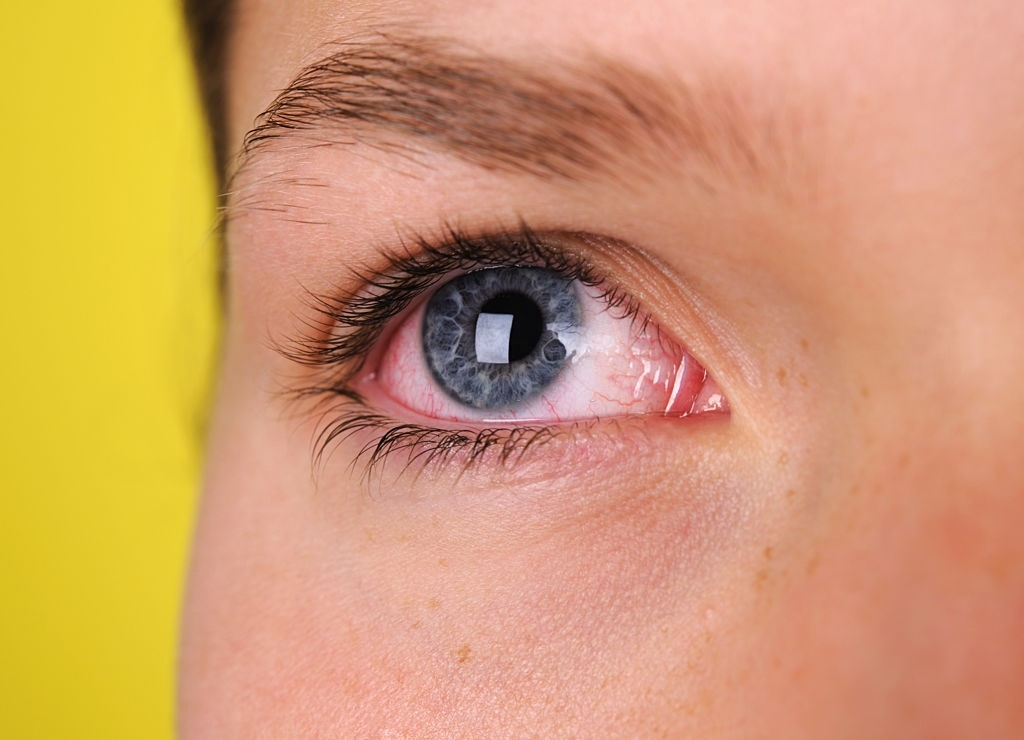
This medication is used to treat an allergy to the eye (allergic conjunctivitis) that can be recognized by eyes and / or swollen eyelids, red eyes, itching or tearing.
2. BEFORE YOU USE ALLERGIFLASH 0.05%, eye drops in solution in single-dose containers?
List of information needed before taking the medication
Not applicable.
Cons-indications
Never use ALLERGIFLASH 0.05%, eye drops in solution in single-dose containers:
· If you are allergic (hypersensitive) to the active ingredient (levocabastine) or any of the other ingredients of ALLERGIFLASH (see section 6 for components ).
Precautions for use; special warnings
Take special care with ALLERGIFLASH 0.05%, eye drops in solution in single-dose containers:
· If you do not feel any improvement or if your symptoms persist, you should consult your doctor.
Interaction with other medicines
Taking other medicines
If you are taking or have recently taken any other medicines, including medicines obtained without a prescription, talk to your doctor or pharmacist.
Interactions with food and beverages
Not applicable.
Interactions with Herbal Medicines or Alternative Therapies
Not applicable.
Use during pregnancy and lactation
Pregnancy and breast feeding
Pregnancy
The use of ALLERGIFLASH 0.05% can be considered with caution during pregnancy.
feeding
Because of the lack of data, the use of levocabastine is not recommended during breast-feeding.
Ask your doctor or pharmacist for advice before taking any medicine.
Sport
Not applicable.
Effects on ability to drive or use machines
Driving and using machines
Patients with visual impairment (mild irritation following instillation) should refrain from driving vehicles or machinery until these symptoms subside.
List of excipients with known effect
Not applicable.
3. HOW TO USE ALLERGIFLASH 0.05%, eye drops in solution in a single-dose container?
Instructions for proper use
Not applicable.
Dosage, Mode and / or route (s) of administration, Frequency of administration and Duration of treatment
Administration mode
Ophthalmic pathway
This medication should be administered to the eye. Under no circumstances should it be injected.
When using this eye drops, follow these steps:
1. Wash your hands thoroughly before applying eye drops.
2. To reduce the risk of infection, avoid contact of the single-dose container tip with the eye or eyelids.
3. Tilt your head back and look at the ceiling.
4. Lower the lower eyelid gently to form a small pocket.
5. Tilt the single dose container over the eye and squeeze it to release a drop in each affected eye.
6. Blink once to allow the eye drops to spread over the entire surface of the eye.
7. With the eye closed, cleanly wipe the excess, especially on the cheek,
8. In order to avoid systemic effects, it is recommended to compress the internal angle of the eye for 1 minute after each instillation,
9. Discard the single-dose container after use. Do not store it for future use.
If concomitant treatment with another eye drops, the instillations should be spaced for 15 minutes.
The amount of eye drops contained in a single dose is sufficient for the treatment of both eyes.
This eye drops contains no preservatives
Symptoms and Instructions for Overdose
If you used more than 0.05% ALLERGIFLASH, eye drops in single dose solution you should not have:
In case of overdose, a falling asleep can be felt. Rinse thoroughly with sterile physiological saline. And just continue your treatment at the next instillation.
Instructions for omission of one or more doses
If you forget to use ALLERGIFLASH 0.05%, eye drops in solution in single-dose containers:
Do not take a double dose to make up for the missed dose, but simply continue with your treatment.
Risk of withdrawal syndrome
Not applicable.
If you have any further questions about the use of your medication, ask your doctor or pharmacist for more information.
4. WHAT ARE POSSIBLE SIDE EFFECTS?
Description of adverse reactions
Like all medicines, this medicine may cause side effects, although not everybody gets them.
Frequently observed conditions (in less than 1 in 10 patients) are:
· Eye pain, blurred vision, burning, tingling, eye irritation.
The rarely observed conditions (in less than 1 in 100 patients) are:
· Swelling (edema) of the eyelids
Very rarely observed conditions (in less than 1 in 10,000 patients) are:
· Conjunctivitis, swelling of the eyes and inflammation of the eyelids, redness of the eye, tearing of the eyes and itching of the eyes.
· Eruption, redness of the skin, allergic reaction which can manifest itself by a sudden swelling of the face and the neck or by a sudden malaise with drop of the blood pressure. In this case, stop treatment immediately and notify your doctor.
· Headache.
In very rare cases, some patients with severe damage to the clear layer in the front of the eye (cornea) have developed opaque deposits on the cornea due to calcium accumulation during treatment.
Declaration of side effects
If you experience any side effects, talk to your doctor or pharmacist. This also applies to any side effects not mentioned in this leaflet. You can also report adverse reactions directly via the national reporting system: National Agency for the Safety of Medicines and Health Products (ANSM) and network of Regional Pharmacovigilance Centers - Website: www.ansm.santé.fr .
By reporting adverse reactions, you are helping to provide more information about the safety of the drug.
5. HOW TO STORE ALLERGIFLASH 0.05%, eye drops in solution in a single-dose container?
Keep out of the reach and sight of children.
Expiration date
Do not use this medicine after the expiry date which is stated on the package. The expiry date refers to the last day of that month.
Storage conditions
Use the single-dose container immediately after opening and discard after use. Do not store it for future use.
If necessary, warnings against visible signs of deterioration
Do not use this medication if you notice any signs of deterioration.
Do not throw any medication into drains or household waste. Ask your pharmacist to remove any medications you are no longer using. These measures will help protect the environment.
6. ADDITIONAL INFORMATION
Full list of active substances and excipients
What is ALLERGIFLASH 0.05%, eye drops in solution in single dose containers?
The active substance is:
Levocabastine ................................................. .................................................. ................................. 0.05 g
In the form of levocabastine hydrochloride
For 100 ml of solution.
The other components are: hydroxypropylbetadecx, monosodium phosphate dihydrate, disodium phosphate dodecahydrate, sodium chloride, purified water.
Pharmaceutical form and content
What is ALLERGIFLASH 0.05%, eye drops in solution in single-dose containers and contents of the pack?
This medicinal product is in the form of eye drops in solution in a single-dose container. Box of 10 single-dose containers of 0,3 ml.
Name and address of the marketing authorization holder and the holder of the manufacturing authorization responsible for the release of the lots, if different
Holder
CHAUVIN LABORATORY
416 RUE SAMUEL MORSE
CS99535
34961 MONTPELLIER CEDEX 2
LA FRANCE
exploiting
CHAUVIN LABORATORY
416 RUE SAMUEL MORSE
CS99535
34961 MONTPELLIER CEDEX 2
LA FRANCE
Maker
LABORATOIRE CHAUVIN SA
ZI RIPOTIER HAUT
07200 AUBENAS
Names of the medicinal product in the Member States of the European Economic Area
Not applicable.
Date of approval of the notice
The last date on which this leaflet was approved is {date}.
AMM under exceptional circumstances
Not applicable.
Internet Information
Detailed information on this medicine is available on the Ansm website (France).
Information for health professionals only
Not applicable.
Other
ADVICE / HEALTH EDUCATION
a) What is an allergy, what is an allergic reaction?
Allergy is an overreaction of our body to substances it considers harmful, allergens. Allergens are the factors and substances triggering allergy and associated disorders.
During repeated contact of the body with the allergen, an allergic reaction is triggered.
The allergic reaction refers to all symptoms appearing a few minutes or hours after exposure to allergens. These allergens come from plants, animal hair, food, dust mites, molds or are substances of occupational origin.
This allergic reaction causes the release in the body of substances such as the histamine responsible for the disorders felt.
Like any allergic disease, it is important to consult a doctor at least once. IT SHALL DETERMINE IN PARTICULAR THE NEED TO CARRY OUT AN ALLERGOLOGICAL BALANCE SHEET.
b) How to recognize allergic conjunctivitis
A redness of the eye and the inside of the eyelids accompanied by itching, swelling and tearing of the eye are signs of allergic conjunctivitis.
This condition often accompanies allergic rhinitis (sneezing, runny nose, stuffy nose) because they are triggered by the same allergens (pollens, mites, animal hair ...).
c) Some practical tips
· Do not rub your eyes, even if they irritate you because after a temporary relief, this friction can only aggravate the situation.
· Gently rinse your eyes with clear water or with a sterile washing solution to remove pollen and so relieve you.
· Temporarily remove the makeup. The healing of conjunctivitis or reappearance during a new application may make it possible to identify the responsible substance. The presence of an eye allergy must lead to be vigilant in the choice of its cosmetics.
· If you wear contact lenses, it is best to remove them for the duration of the treatment with eye drops.
d) In case of acute eye pain, sensation of decreased vision or visual blur, consult your doctor.
e) Prevention of recurrences
· Removing the allergen (is foreclosure) is the measure of choice to suppress or reduce the symptoms of allergy.
· For allergens in the home, measures to reduce the presence of allergens are essential:
· The mattress should be completely surrounded by a plastic dust mite cover as well as the pillows. The bed base, unless it is in slats or metal, shall be surrounded by a plastic. Any bedding should be washed twice a month at 60 ° C if possible.
· The room should be ventilated and cleaned regularly.
· On the floor, you will avoid bed runs and carpets.
· Avoid pets.
· During the pollen season it is possible to reduce the exposure to pollen:
· In your garden, diversify the plantations avoiding the most allergenic species (cypress, thuja, birch ...).
· Avoid mowing the lawn yourself during the pollen season.
· Garde preferably with glasses and protective mask.