When should you use Seresikan for your cat?
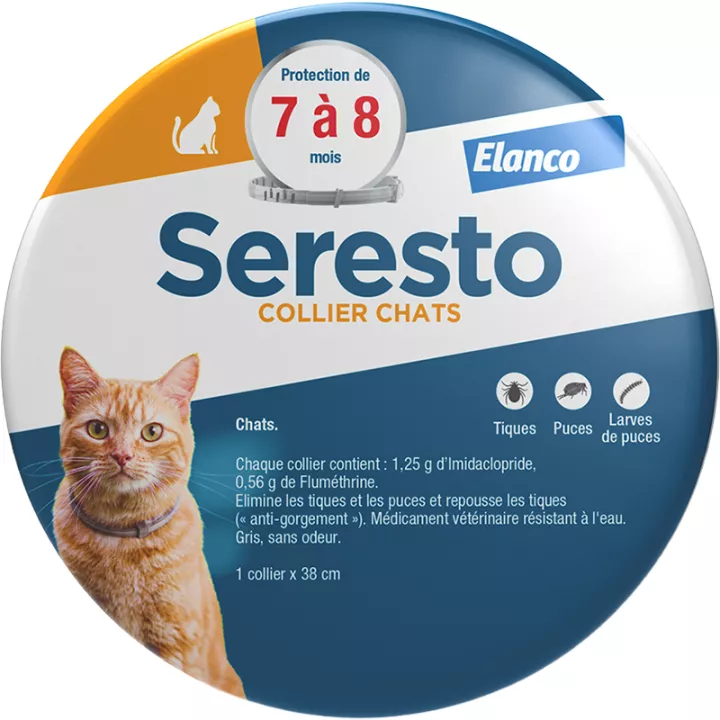
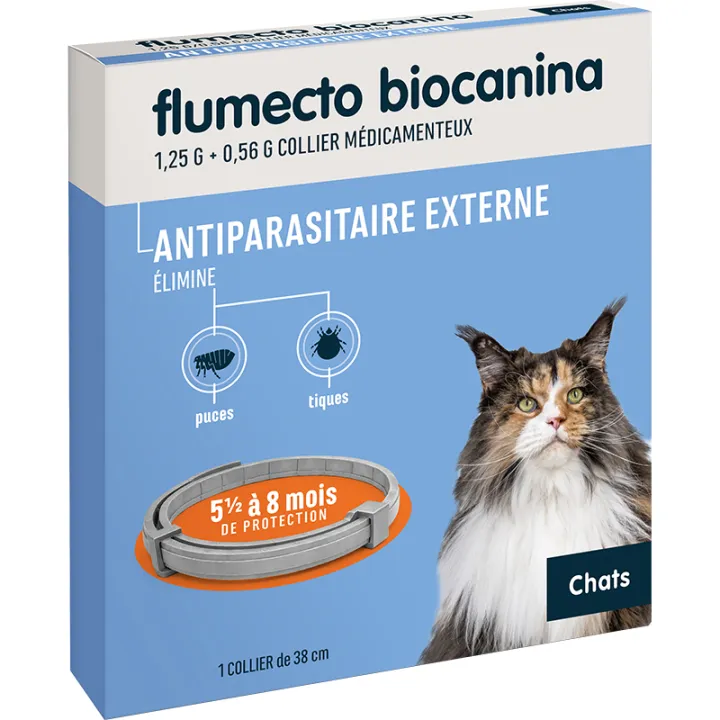
Seresikan Clément Thékan 1.25 g + 0.56 g is a veterinary medication for cats, available as a 38-cm collar. It combines two active ingredients: imidacloprid, an insecticide in the chloronicotinoid class, and flumethrin, a synthetic pyrethroid. These substances are released slowly and continuously from the collar’s matrix at low concentrations and then spread over the entire surface of the skin and coat.
Seresikan is intended for cats infested with or at risk of mixed infestations by fleas and ticks, and it is indicated only when these parasites are present simultaneously. For fleas, it treats flea infestations and prevents reinfestation by fleas (Ctenocephalides felis) thanks to its insecticidal activity lasting 7 to 8 months. It protects the animal’s immediate environment against the development of flea larvae for 10 weeks.
For ticks, the collar prevents reinfestation by ticks (Ixodes ricinus) through its acaricidal (lethal) and repellent (anti-feeding) effects, beginning within 2 days of applying the collar and lasting up to 8 months. Against Rhipicephalus turanicus, prevention of reinfestation relies on its acaricidal (lethal) effect, with the same onset time and duration. It is effective against larvae, nymphs, and adult ticks.
When a veterinarian has diagnosed flea bite allergic dermatitis (FBAD), Seresikan can be part of the treatment strategy to manage the condition. It is particularly beneficial for cats that go outdoors and come into contact with yards, tall grass, or other animals. Ideally, the collar should be applied before the start of flea and tick season. To compare the different options, consult our guide to choosing a flea and tick collar for dogs or cats.
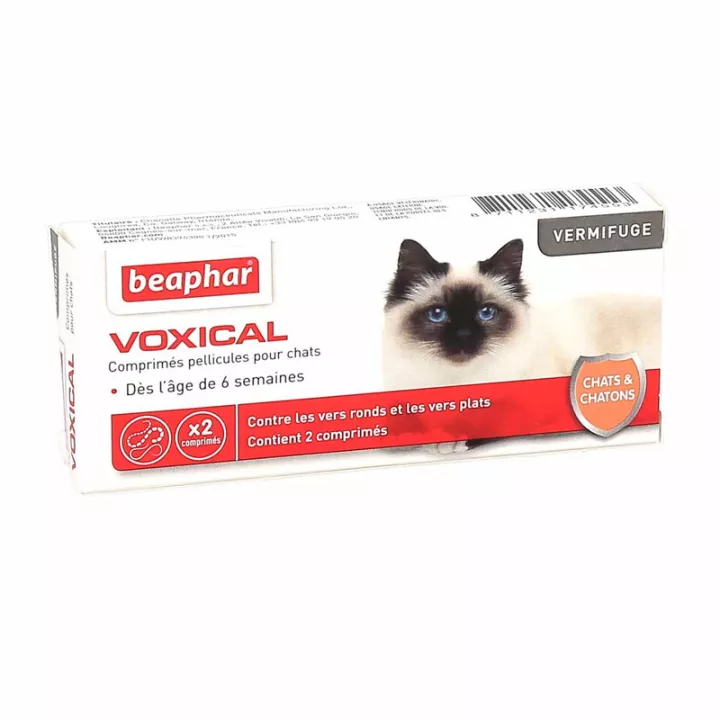
We recommend using it in combination with Beaphar Voxical Dewormer for Cats and Kittens. Fleas serve as intermediate hosts for certain intestinal worms in cats: the collar targets fleas externally, while the oral dewormer targets the worms internally. The two products do not share any active ingredients.
How do you put this flea and tick collar on your cat?
Directions for Use
For topical use only: one 38 cm collar per cat, to be fastened around the neck.
- Remove the collar from the protective pouch just before use, unroll it, and check that no remnants of the plastic fastening tab remain inside.
- Adjust the collar around the neck without tightening it too much: you should be able to fit two fingers between the collar and the neck.
- Thread the remaining part of the collar through the buckle, cut off any excess length beyond 2 cm, and dispose of the scraps immediately.
- Wear the collar continuously for 8 months, then remove it.
- Check the fit regularly, especially in growing kittens.
Share your feedback on the usage instructions and dosage for Seresikan Clément Thékan 1.25 g + 0.56 g medicated collar for cats (38 cm) with our partner “Verified Reviews” after your purchase.
Precautions
- Do not treat kittens younger than 10 weeks. Do not use in case of hypersensitivity to the active ingredients or any of the excipients.
- For cats only. Never put a collar or parasite treatment intended for dogs on a cat.
- Use is not recommended in pregnant or nursing cats.
- Ticks already present before application may not be killed within 48 hours and may remain attached: remove them at the time of application. It is still possible for a tick to attach itself after treatment; therefore, the transmission of infectious diseases by ticks cannot be completely ruled out under unfavorable conditions.
- If there is no risk of simultaneous flea and tick infestation, a product with a narrower spectrum of activity is preferable. Do not combine with another topical parasite control product without consulting a veterinarian.
- The collar is water-resistant and remains effective if the cat gets wet, but avoid shampooing and prolonged, intense exposure to water, which can reduce its duration of effectiveness.
- Other animals in the household may be a source of reinfestation and should be treated as needed with an appropriate product. In a heavily infested home, treat sleeping areas with an appropriate insecticide and vacuum regularly.
- If there is a severe skin reaction under the collar or if symptoms persist, consult your veterinarian; it may be necessary to remove the collar.
- Accidental ingestion may cause adverse effects, including neurotoxicity. Do not allow young children to play with the collar or put it in their mouths. Keep the pouch in the box until ready to use. In case of accidental ingestion, seek medical attention immediately and show the doctor the package insert or label.
- People allergic to the collar’s ingredients or to iron oxides: Avoid all contact with the collar and the treated animal. In very rare cases, the collar may irritate the skin, eyes, or respiratory tract: if irritation occurs, rinse the eyes or wash the skin with cold water and soap, then consult a doctor if symptoms persist.
- Avoid prolonged contact with the collar, both when applying it and while it is being worn, especially during pregnancy. Wash your hands with cold water after applying the collar. Cats wearing the collar should not sleep in their owners’ beds, especially those of children.
- Imidacloprid and flumethrin may harm aquatic organisms; imidacloprid is toxic to bees. Do not dispose of the collar or any leftover pieces in sewers, waterways, or household trash: use collection programs for unused veterinary medications.
- Keep the pouch in the outer packaging until ready to use. Read the package insert carefully before use.
What are the active ingredients in this medicated collar for cats?
Active Ingredients
| Active ingredient |
Amount per 38 cm collar (12.5 g) |
| Imidacloprid |
1.25 g |
| Flumethrin |
0.56 g |
Inactive ingredients
Titanium dioxide (E 171) 0.063 g, Black iron oxide (E 172) 0.010 g, Brown iron oxide (E 172) 0.005 g, Yellow iron oxide (E 172) 0.010 g, Dibutyl adipate, Propylene glycol dicaprylate/caprate, Epoxidized soybean oil, Stearic acid, Polyvinyl chloride.
Packaging
Box containing one 38 cm light gray collar, individually packaged in a pouch, providing 8 months of wear.
Our expert advice on Seresikan for cats
The most important step happens before you buy: make sure the collar is actually for your cat. Flea and tick treatments for dogs can contain substances that are highly toxic to cats, and mix-ups between the two types of collars still happen at home when dogs and cats share the same household. Next, proper fitting ensures comfort: leave two fingers’ width of space under the collar—no more, no less—and check the fit weekly for kittens.
Note the date it was put on in your calendar or on the back of the box: after eight months, the collar should be removed and replaced, even if it still looks in good condition. If the collar is lost before the end of this period, ask us for advice before putting on a new one.
FAQ
Does the Seresikan collar lose its effectiveness on my cat over time?
During periods of heavy shedding, a slight, temporary decrease in effectiveness is possible, as some of the active ingredients attached to the fur are lost. The collar continues to release its active ingredients: full effectiveness returns without additional treatment or replacement. However, shampoos and prolonged soaking can shorten the duration of effectiveness.
My cat has redness or is losing fur under the Seresikan collar: what should I do?
Redness, hair loss, or itching around the neck are rare reactions that usually disappear within one to two weeks; temporarily removing the collar may be recommended. A more severe reaction (eczema, sores, bleeding) warrants removing the collar and consulting a veterinarian.
Can my cat get stuck wearing the Seresikan collar?
The Seresikan cat collar features a safety clasp. In the very rare event that a cat becomes trapped, its own strength is usually enough to break the collar and free itself. A properly adjusted collar, fitting snugly around the neck, also minimizes this risk.
My Seresikan cat collar is covered in a fine white powder—is this normal?
Yes. The Seresikan collar is light gray and may have slight traces of white powder when taken out of the package. This is normal and does not affect its use.