What is the purpose of the natural treatment against Varroa mites, American foulbrood, and nosemosis?
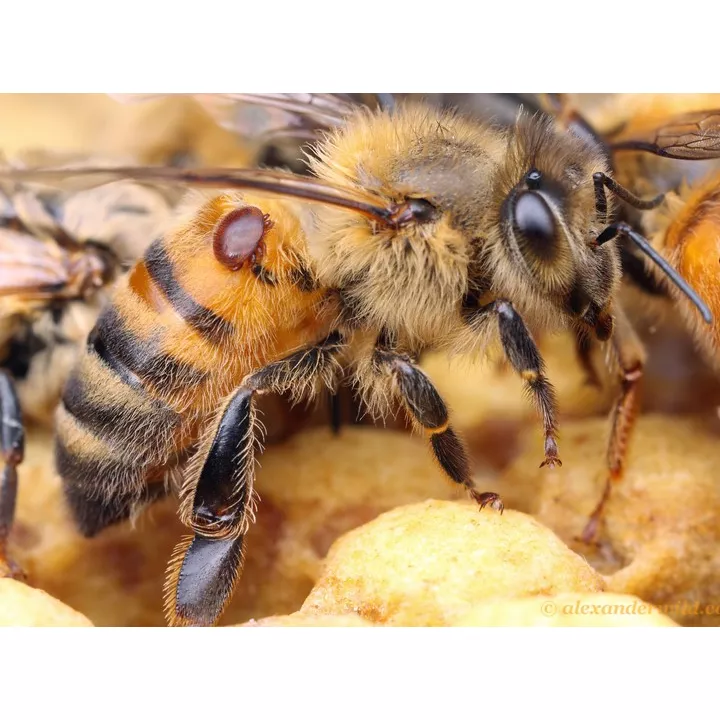
Eucalyptus contains a high concentration of the active monoterpene eucalyptol; lavender also contains a high concentration of the active monoterpene linalool, as well as a small amount of eucalyptol; clove contains a high concentration of eugenol and a small amount of linalool; geranium contains a high concentration of geraniol; and vetiver contains vetivenone and the active compound vetivenol. All other constituents found in essential oils also help to enhance or potentiate the effects of the active monoterpenes on parasites and certain pathogens (by increasing their penetration into pathogens) than when used alone, with an additional caustic and highly irritating effect on the keratin of the Varroa mite.
Vetiver essential oil is used purely to physically stimulate the bees and to boost their immune system for disease resistance.
This blend can be usedonly in the spring, summer, or fall.
Forwinter, use only pureEucalyptus globulus essential oilbefore counting varroa mites—you’ll be surprised. This is very revealing regarding varroa mites: 4 drops of Eucalyptus globulus essential oil on a piece of Canson paper placed under the frames near the main entrance—a strip 20 cm wide and spanning the full length of the frame will suffice— the varroa fall rate multiplier is 50 starting on the second day, meaning a count on the third day will determine the number of fallen varroa mites and the total number of varroa mites in the hive that must be eliminated. Never use a mixture that is too concentrated for winter, as the cold increases the irritating effect of essential oils on the bees.
We also offer our essential oil preparation for recurrent herpes at the best price in our online pharmacy.
How should this essential oil blend be used?
The hives were treated during the same months every year (April, June, August, October), with three treatments during each of these months, spaced one week apart, allowing for 7 hours of contact, using a wooden stick (10 cm long and 7 mm thick); the sticks were impregnated with essential oils after being soaked along a 2- to 3-cm section of the stick, then allowed to drip onto the mixture and subsequently onto the remainder of the stick.
The stick is inserted through the hive entrance, leaving a small portion protruding from the exit so it can be retrieved for future treatments; the wood has the property of absorbing the essential oils at its surface and slowly diffusing them until the diffusion is completely exhausted. After 7 hours of contact, even if the oils have dripped onto the hive tray, they remain absorbed into the tray and the stick; the fairly strong scent lingers for 3 days on the wooden strip and for one day on the hive tray (because the bees fan the hive).
The dosage is four drops per hive using a standard dropper and two drops per small hive, which should be placed as close as possible to the main entrance of the hive or small hive, or on a piece of Canson paper to be inserted into the hive through the main entrance if the hive tray is made of plastic, since essential oils are incompatible with plastic. Then let the mixture diffuse and do nothing else; the treatment is complete for the day and for the week. The advantage of this technique is that there is no need to open the hive roof, so there is no sudden cooling inside the hive, provided the usage instructions in the “VERY IMPORTANT” section are followed.
Precautions for Use
Never treat in cold, windy weather or during rain; always treat in fair weather or when it is partly cloudy. In winter, never treat when the temperature is below 6°C, and always wait until early afternoon. However, never treat in the late afternoon, as temperatures drop rapidly in the early evening. Bees fan to dispel the odors of essential oils, which spread very quickly and permeate the hive—this also bothers the bees when the weather is cold or damp, as bees are sensitive to sudden humidity or sudden cold, so be very mindful of the weather following any treatment.
Another important point: a reduction in brood area has been observed during nectar flows when using thyme essential oil, as well as a failure to replace the queen when creating an artificial swarm—whether in the artificial swarm itself or in the mother hive used to create it. Therefore, as a safety precaution, never treat the day before creating an artificial swarm; always perform the final treatment—as a precaution—one week before creating an artificial swarm, as the queen will easily resume laying eggs starting on the 2nd or 3rd day after treatment.
However, always perform treatments before installing the supers, or the honey in the supers may take on a treatment odor, as the essential oils permeate everything for several days: the wood, propolis, honey, wax, and the keratin coating of the bees and varroa mites, as well as the pollen.
What is its composition?
According to a study by Ludovic LABESTE, Ph.D. in Pharmacy
The formula for the mixture during spring, summer, or fall is as follows:
- geranium essential oil (Pelargonium graveolens), 4 ml or 80 drops
- fine lavender essential oil (Lavandula officinalis), 4 ml or 80 drops
- clove essential oil (Eugenia caryophyllata), 4 ml or 80 drops
- vetiver essential oil (Vetiveria zizanioides), 1 ml or 20 drops
- Eucalyptus radiata essential oil, q.s. to 250 ml.
Packaging
250-ml bottle of the essential oil blend
Essential oils are very stable between 10° and 20°C when stored away from light, especially when packaged in large quantities.