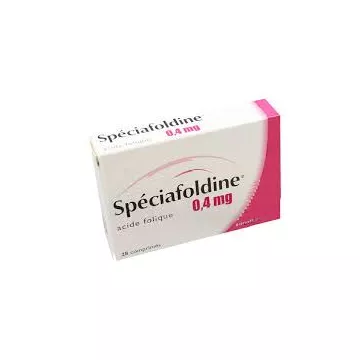
What is vitamin B9 (folate), and how does it differ from folic acid?
Vitamin B9 refers to the folate family—water-soluble coenzymes that are essential for DNA synthesis, cellular methylation, and red blood cell formation. Natural (dietary) folates and folic acid (synthetic) follow different metabolic pathways. Find our B vitamins at your local pharmacy to discover the forms of vitamin B9 best suited to your genetic profile.
- Natural folates (from food): polyglutamates → hydrolyzed into monoglutamates in the small intestine → absorbed → converted into 5-methyltetrahydrofolate (5-MTHF) in the intestinal lining → active form circulating in the plasma
- Folic acid (synthetic): stable oxidized form — requires two successive enzymatic reductions (DHFR → THF → 5-MTHF) before becoming biologically active — metabolism is partially saturable at high doses → possible accumulation of unmetabolized folic acid (UMFA) in the blood
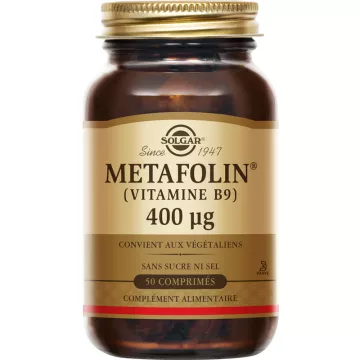
- 5-MTHF (methylfolate, L-methylfolate): directly bioactive form — does not require enzymatic conversion — available in supplements (Metafolin®, Quatrefolic®) — indicated in cases of MTHFR polymorphism or poor folic acid conversion
- MTHFR polymorphism: C677T variant (present as a homozygous variant in 10–15% of the Caucasian population) → MTHFR enzyme (methylenetetrahydrofolate reductase) with 30–70% reduced activity → reduced conversion of folate to 5-MTHF → ↑ homocysteine → increased cardiovascular and neurological risk — solution: direct supplementation with 5-MTHF rather than folic acid
- Folate cycle and methylation: 5-MTHF donates its methyl group to vitamin B12 (cobalamin) → production of methionine → S-adenosylmethionine (SAM) = the body’s primary methyl donor (methylation of DNA, neurotransmitters, phospholipids) — vitamin B9 and vitamin B6 work synergistically in this cycle
Essential Functions and Vitamin B9 Deficiency
- DNA and RNA synthesis: tetrahydrofolate (THF) is essential for the biosynthesis of purines and pyrimidines (thymidylate synthase) — any rapidly dividing cell (bone marrow, intestinal epithelium, fetus) is particularly susceptible to deficiency
- Megaloblastic anemia: B9 deficiency → inhibition of DNA synthesis in erythroblasts → non-functional giant macrocytes → macrocytic anemia — to be distinguished from B12 deficiency anemia (same clinical presentation) — comprehensive evaluation: erythrocyte folate levels + B12 + complete blood count
- Homocysteine: 5-MTHF is essential for the remethylation of homocysteine to methionine — B9 deficiency → hyperhomocysteinemia → cardiovascular risk (thrombosis, atherosclerosis) + neurological risk (dementia, depression) — combine B9 + B12 + B6 to effectively reduce homocysteine
- Mental Health: Folates are necessary for the synthesis of monoamines (dopamine, serotonin, norepinephrine) via the methylation cycle — deficiency → depression + cognitive impairments + mental fatigue — clinical studies: B9 supplementation enhances the effectiveness of antidepressants as an adjunct therapy
- Neural development and myelination: essential for neurogenesis and fetal myelination — preconception deficiency = a major risk factor for spina bifida, anencephaly, and other neural tube defects
Dietary sources and requirements based on individual profiles
- Foods richest in folate: veal liver (261 µg/100 g) — raw spinach (194 µg/100 g) — asparagus (149 µg/100 g) — cooked lentils (181 µg/100 g) — chickpeas (172 µg/100 g) — nutritional yeast (1,000 µg/100 g) — avocados (81 µg/100 g)
- Losses during cooking: Natural folates are heat-sensitive — boiling → 50–80% loss — opt for steaming, eating raw, or brief cooking — folates are also light-sensitive (store vegetables away from light)
- RDA for vitamin B9: adults 330 µg/day dietary folate equivalents (EFA) — pregnant women 600 µg/day — breastfeeding women 500 µg/day — children 160–300 µg/day depending on age — tolerable upper intake level (synthetic folic acid): 1,000 µg/day (risk of masking a B12 deficiency)
- At-risk populations: women of childbearing age (preconception requirements) — chronic alcoholics (B9 is most affected by alcohol — intestinal competition + increased renal excretion) — vegans without a varied diet — people taking methotrexate (folate antagonist) or antiepileptic drugs (phenytoin, carbamazepine) — MTHFR C677T homozygotes
- Diagnosis: plasma folate levels (< 3 µg/L = deficiency) + erythrocyte folate levels (reflecting reserves, < 140 µg/L = deficiency) + plasma homocysteine (> 15 µmol/L = functional deficiency or MTHFR polymorphism)
Supplementation, drug interactions, and precautions
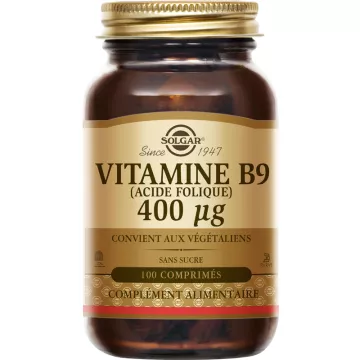
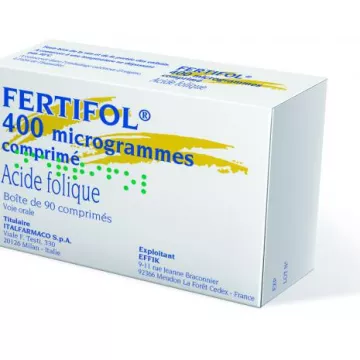
- Forms of supplementation: standard folic acid (400–800 µg/day, sufficient for most people) — 5-MTHF (L-methylfolate, 400–800 µg/day, indicated for MTHFR+ individuals and poor responders to folic acid) — Quatrefolic® or Metafolin® methylfolate (patented forms of 5-MTHF, directly bioactive)
- Methotrexate: DHFR antagonist → blocks folate conversion → THF → accumulation of inactive folates → toxic effects (mucositis, cytopenias) — routine folic acid supplementation on day 2 of each MTX injection (not on the day of the injection) to limit side effects without reducing efficacy
- Antiepileptic drugs (phenytoin, carbamazepine, valproate, phenobarbital): induce liver enzymes → accelerate folate catabolism → deficiency during chronic treatment — supplementation recommended under medical supervision — theoretical risk of interaction affecting seizure control (monitor)
- Vitamins B12 and B9: never supplement with B9 alone without measuring B12 levels — High-dose folic acid can correct megaloblastic anemia caused by B12 deficiency by masking the deficiency — but B12-deficiency neuropathy continues to progress → perform a comprehensive evaluation before supplementation
- Excess folic acid (UMFA): doses > 1,000 µg/day of synthetic folic acid → unmetabolized folic acid (UMFA) in circulation → emerging data on immunomodulation + hypothesis of interaction with B12 metabolism in older adults—prefer high-dose 5-MTHF in those over 65