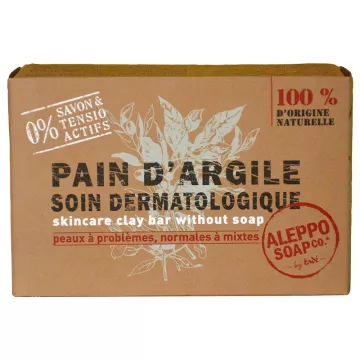
What is clay soap, and how does clay affect the skin?
Clay soap is a plant-based soap in which mineral clay is incorporated into the saponified base. Clay is not a lipid-based active ingredient—it is a mineral clay whose primary action is adsorption: it binds impurities, excess sebum, and residues on the skin to its surface like a mineral magnet.
- Clay does not “detoxify” in the medical sense—it absorbs residues from the skin’s surface during contact time (which is why it’s best to let it sit briefly before rinsing)
- Its exfoliating action is mechanical and gentle—the clay particles gently scrub the skin’s surface without being harsh like plastic microbeads
- It regulates sebum production by absorbing excess sebum—particularly useful for combination to oily skin
- Result after rinsing: skin feels “tight,” with a deep sense of cleanliness—those with dry skin should be cautious, as they may find this effect too astringent
Green, white, pink, red clay: which one should you choose for your skin?
The type of clay is the most important factor in a clay soap—each has different absorbency and gentleness.
- Green clay (illite): the most absorbent and purifying — for oily and acne-prone skin — may dry out dry or sensitive skin — recommended frequency: 3–4 times a week maximum
- Kaolin (white clay): the gentlest of all clays—low absorbency but with a mild mattifying effect—for sensitive and dry skin, as well as children—suitable for daily use
- Pink clay: a blend of red clay (iron-rich) and kaolin—intermediate—for normal to sensitive skin types seeking a gentle purifying effect without harshness
- Red clay (ghassoul): native to Morocco, very rich in magnesium and silica—particularly recommended for oily scalps and combination skin—distinctive earthy scent
- Gray or black clay (activated charcoal): technically not a clay in the mineralogical sense—activated vegetable charcoal, very high adsorbing power—for very oily skin and enlarged pores—for use on the body and feet
Clay soap vs. traditional purifying soap: what is the real added value?
Clay adds a dimension that surfactants alone cannot replicate—but it doesn’t work miracles.
A classic purifying soap (with salicylic acid, for example) acts chemically on keratinocytes and the skin’s microbiome—targeting acne. Clay soap works physically by adsorbing impurities and regulating surface sebum—it’s gentler and carries no risk of chemical irritation. For mild to moderate acne, green clay soap is often sufficient as a daily cleanser. For severe acne, a targeted dermatological treatment is needed in conjunction with it.
How should you use clay soap to maximize its effects?
- Lather it in your hands first—apply the lather to the skin without rubbing the bar directly on sensitive areas
- Leave on for 30–60 seconds before rinsing—this contact time significantly improves the clay’s ability to absorb impurities
- Rinse with lukewarm water—cold water can “close” the pores before the clay has had time to work
- Pat dry, then apply toner followed by a suitable moisturizer—kaolin dries the skin only slightly, while green clay may leave a drying sensation that needs to be counteracted
- Frequency: green clay 2–4 times a week at most; kaolin: can be used daily
- See our body care line