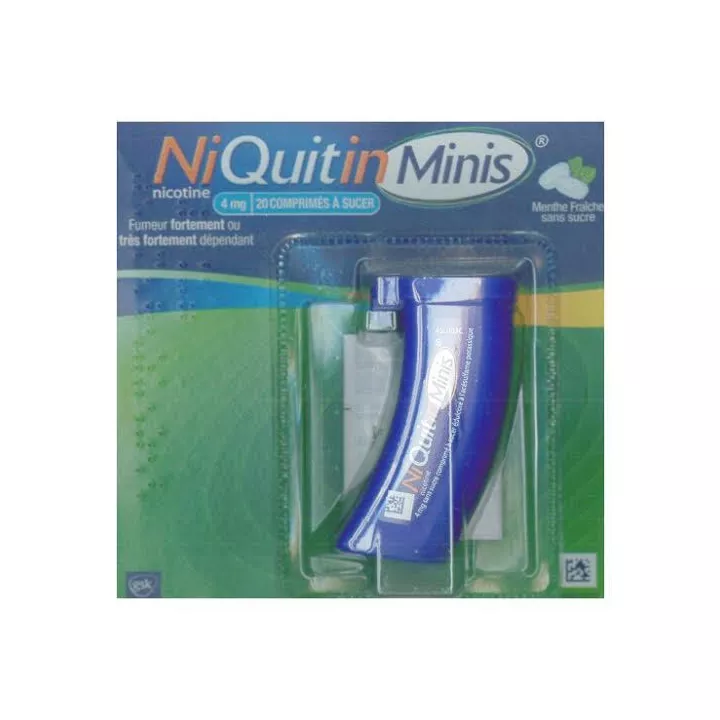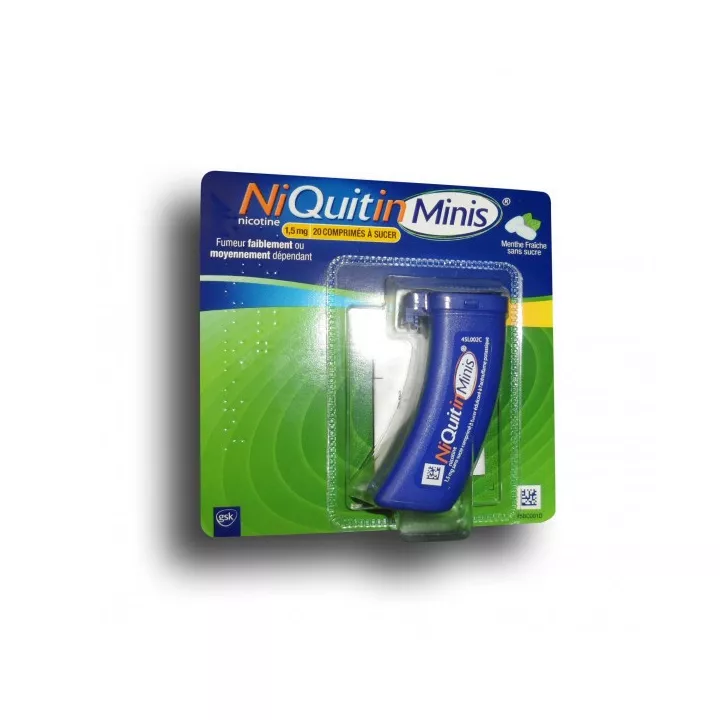
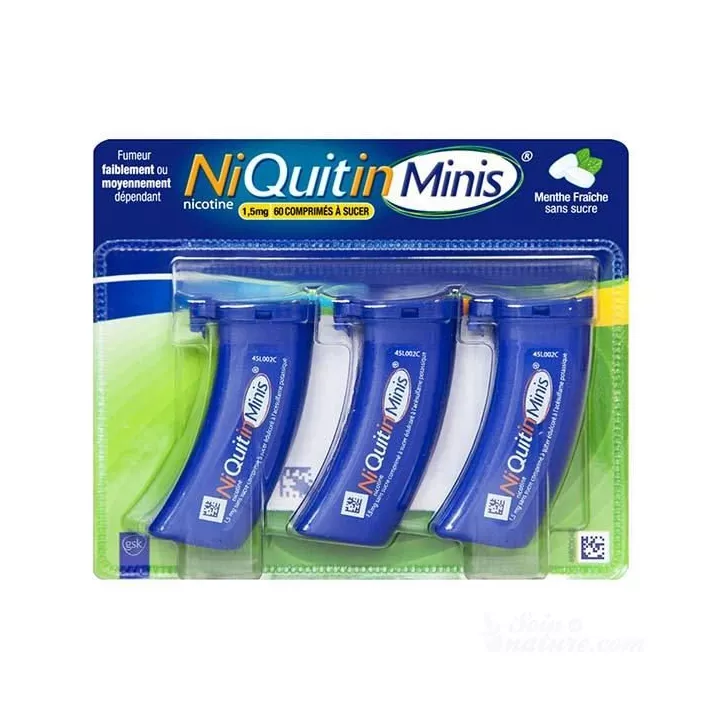
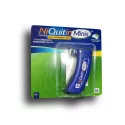
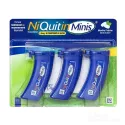
Niquitin Minis 1.5 mg Menthe Fraîche 20 or 60 Tablets on sale in our online pharmacy, is indicated in the treatment of tobacco dependence, to relieve nicotine withdrawal symptoms in subjects wishing to stop smoking.

For warnings, precautions and contraindications, please refer to the package leaflet.
Niquitin Minis 1.5 mg Fresh Mint 20 or 60 Sugarfree tablets are always at hand, and all day long, they enable you, with an easy and discreet gesture, to fight effectively against your feelings of craving. They melt in your mouth in around 10 minutes, so you can quickly put an end to your cigarette cravings: with their fresh mint flavour and nomadic format, you can take them with you wherever you go. The tablets are designed for smokers who want to be active in their withdrawal and choose when to take their treatment, as they attach great importance to maintaining a certain gesture.
Preparing for D-Day
Today marks the beginning of your new life as a non-smoker. You've chosen this date to free yourself from the clutches of tobacco - be proud of it! Knowing when to stop smoking and setting a specific date in advance will help you prepare for this change. Your decision to stop smoking won't be made on the spur of the moment, but will be carefully considered.
As a first step, throw away your last packets and all your smoking accessories (lighters, ashtrays). Tell the people around you so that they can support you in your decision, and plan your day so as to occupy as much of your time as possible. Avoid all situations previously associated with smoking: coffee breaks between smokers, coffee after meals, dinner with smoking friends, etc.
Acesulfame potassium-sweetened tablets should not be given to children under 18 without a doctor's prescription. There are no data evaluating treatment with this drug in subjects under 18 years of age.
Adults and elderly subjects:
The 1.5 mg chewable tablet is indicated for smokers with low to moderate nicotine dependence, i.e. those who smoke their first cigarette more than 30 minutes after waking up.
Complete cessation of smoking
Nicotine dependence is usually treated in 3 stages.
To help you continue to quit after 12 weeks: 1 to 2 sucking tablets a day only in case of strong temptations.
During weeks 1 to 6, the dosage should be at least 9 sucking tablets a day.
In no case should the number of tablets sucked exceed 15 per day.
Temporary abstinence from smoking
Suck one tablet each time you feel the urge to smoke.
The number of 1.5 mg tablets should not exceed 15 per day.
Slowly suck the tablet for the required time (10 minutes for NiQuitinMinis), moving it back and forth in your mouth until it is completely dissolved. The tablet should not be chewed or swallowed, as nicotine is gradually released and must be absorbed by the oral mucosa. Do not eat or drink while the tablet is in your mouth.
The active substance is nicotine 1.5 mg, in the form of nicotine resinate 7.5 mg for one sucking tablet.
Other ingredients are: mannitol, sodium alginate, calcium polycarbophil, sodium carbonate anhydrous, xanthan gum, magnesium stearate, acesulfame potassium, potassium bicarbonate, "takasago saveur masquante" flavoring, peppermint flavoring, menthol flavoring.
Notable excipients: mannitol, aspartam, potassium bicarbonate.
IF IN DOUBT, ASK YOUR DOCTOR OR PHARMACIST FOR ADVICE.
Certain illnesses require medical examination and monitoring before using this product. For example, in case of :
It is essential to consult your doctor before using this medicine.
Sucking tablets must be kept out of the reach of children (serious, even fatal, poisoning).
Certain signs indicate underdosing. If, despite treatment, you experience withdrawal symptoms such as: craving for cigarettes, irritability, sleep disturbances, restlessness or impatience, difficulty concentrating. Consult your doctor or pharmacist. It may be necessary to adjust the dosage.
Certain signs may indicate overdosage: if signs of overdosage appear, i.e. nausea, abdominal pain, diarrhea, hypersalivation, sweating, headache, dizziness, hearing loss, general weakness. It is imperative to adopt the treatment with the advice of your doctor or pharmacist.
Smoking leads to deficiencies in vitamin C (ascorbic acid) and vitamin E (tocopherol).
Vitamin E and vitamin C are antioxidants, capable of neutralizing the free radicals produced in our bodies during inflammatory processes (smoking, cancer, Alzheimer's disease). Free radicals generated by tobacco smoke progressively destroy alveolar membranes.
Vitamin E (tocopherol) acts in synergy with vitamin C, which explains why vitamin C intake significantly reduces the vitamin E deficiency observed in tobacco smokers.
Tobacco smokers are always deficient in vitamin E and vitamin C, which is why we recommend dietary supplements rich in natural bioavailable vitamin C (acerola) and vitamin E.
IF IN DOUBT, ASK YOUR DOCTOR OR PHARMACIST FOR ADVICE.
Taking or using other medicines:
Please tell your doctor or pharmacist if you are taking or have recently taken any other medication, even if obtained without a prescription. Stopping smoking may alter the action of certain medications. Talk to your pharmacist or doctor.
If you are pregnant or breast-feeding:
Ask your doctor or pharmacist for advice before taking any medication.
Box of 20 and 60 chewable tablets.
Warning: this medicine is not like any other. Read the package leaflet carefully before ordering. Keep medicines out of the reach of children. If symptoms persist, ask your doctor or pharmacist for advice. Beware of incompatibilities with your current products.
Pharmacovigilance Report an adverse drug reaction(s)
NOTICE
ANSM - Updated on : 01/03/2023
Name of medicinal product
NIQUITINMINIS MENTHE FRAICHE 1.5 mg SWEETENER-FREE, sweet tooth tablet sweetened with lacésulfame potassique
Nicotine
Box
Please read this leaflet carefully before taking this medicine, as it contains important information for you.
You must always take this medicine exactly as instructed in this leaflet or by your doctor or pharmacist.
- Keep this leaflet. You may need to read it again.
- Ask your pharmacist for advice and information.
- If you experience any side effects, talk to your doctor or pharmacist. This also applies to any side effects not mentioned in this leaflet. See section 4.
- You should contact your doctor if you do not feel any improvement or if you feel less well.
What does this leaflet contain?
1. What is NIQUITINMINIS MENTHE FRAICHE 1.5 mg SUGAR-FREE, lacesulfame potassium-sweetened tablet and what is it used for?
2. What do I need to know before taking NIQUITINMINIS MENTHE FRAICHE 1.5 mg SWEETENING TABLET sweetened with lacésulfame potassique?
3. How do I take NIQUITINMINIS MENTHE FRAICHE 1.5 mg SUGAR-FREE, lacésulfame potassium-sweetened tablets?
4. What are the possible side effects?
5. How to store NIQUITINMINIS MENTHE FRAICHE 1.5 mg SUGAR-FREE, lacésulfame potassium-sweetened tablets?
6. Package contents and other information.
1. WHAT IS NIQUITINMINIS MENTHE FRAICHE 1.5 mg SWEETENING TABLET SWEETENED WITH LACESULFAME POTASSIQUE AND WHAT IS IT USED FOR?
Drugs used in nicotine dependence - ATC code: N07BA01.
This drug is indicated in the treatment of tobacco dependence, to relieve nicotine withdrawal symptoms in subjects wishing to stop smoking.
Although it is preferable to stop smoking altogether, this drug can be used in :
- when a smoker is temporarily abstaining from smoking,
- a smoking reduction strategy as a step towards permanent cessation.
You should consult your doctor if you do not feel any improvement or if you feel less well.
2. WHAT DO I HAVE TO KNOW BEFORE TAKING NIQUITINMINIS MENTHE FRAICHE 1.5 mg SUGAR-FREE, sweetened tablets with potassium sulfate?
Never take NIQUITINMINIS MENTHE FRAICHE 1.5 mg SWEETENER-FREE tablets sweetened with potassium sulfate:
- if you are allergic to the active substance or to any of the other ingredients listed in section 6.
- if you do not smoke or if you are an occasional smoker.
If in doubt, ask your doctor or pharmacist.
Warnings and precautions
In order to successfully stop smoking, it is essential to quit completely. Read the health education advice carefully.
Certain diseases require medical examination and follow-up before using this medicine. For example, in the case of :
- cardiovascular disease, severe hypertension or heart failure
- cerebrovascular disorder or arteritis of the lower limbs
- diabetes
- severe hepatic and/or renal insufficiency,
- ulcer of the stomach or duodenum,
- seizures or history of seizures
- Uncontrolled hyperthyroidism
- Adrenal gland tumor (pheochromocytoma).
Ask your doctor before taking NIQUITINMINIS MENTHE FRAICHE 1.5 mg SUGAR-FREE, sucking tablet sweetened with lacésulfame potassique. Certain signs indicate an underdose. If, despite treatment, you experience a sensation of "withdrawal", such as
o urge to smoke
o irritability, sleep disturbances,
o agitation or impatience,
o difficulty concentrating.
Consult your doctor or pharmacist. It may be necessary to adjust the dosage.
Certain signs may indicate overdosage: in the event of signs of overdosage, i.e. :
o nausea, abdominal pain, diarrhea,
o hypersalivation,
o sweating, headache, dizziness, hearing loss,
o general weakness.
It is imperative that you adapt your treatment with the advice of your doctor or pharmacist.
- If you have stomach or duodenal ulcers or inflammation of the spleen or throat (the passage between the mouth and stomach), nicotine replacement therapy may aggravate your symptoms.
- if you are diabetic, you should check your blood sugar levels more regularly than usual when you start taking NIQUITINMINIS MENTHE FRAICHE 1.5 mg SUGAR-FREE, sugar-sweetened chewable tablet. sweetened with potassium desulfame, as this medicine may affect your insulin requirements or your treatment.
- if you are hospitalized following a heart attack, severe heart rhythm disturbance or stroke, it is recommended that you stop smoking without using nicotine substitutes, unless your doctor advises otherwise. Once you have been discharged from hospital, you can use nicotine replacement products as usual.
- if you have a heart condition, you should consult a doctor before taking nicotine replacement products.
If in doubt, ask your doctor or pharmacist.
Taking this medicine may lead to dependence.
Children and adolescents
Sucking tablets should be kept out of the reach of children. The therapeutic dose intended for adults could cause serious or even fatal poisoning in children.
Other medicinal products and NIQUITINMINIS MENTHE FRAICHE 1.5 mg SUGAR-FREE, sweetened tablets with lacésulfame potassique
Tell your doctor or pharmacist if you are taking, have recently taken or may take any other medicines.
Stopping smoking, with or without this medicine, may alter the action of certain medicines taken at the same time. This is particularly important if you are taking clozapine, methadone, ropinirole or theophylline. Dose adjustments by your doctor may be necessary. NIQUITINMINIS MENTHE FRAICHE 1.5 mg SUGAR-FREE, sweet tablet sweetened with lacésulfame potassique with food and drink
Not applicable.
Pregnancy and breast-feeding
If you are pregnant or breast-feeding, think you may be pregnant or are planning to become pregnant, ask your doctor or pharmacist for advice before taking this medicine.
Pregnancy
It is very important to stop smoking during pregnancy, as it may affect the course of your pregnancy. Delayed fetal growth, premature delivery and late fetal death have been observed in pregnant smokers.
Smoking cessation during pregnancy requires medical advice and follow-up. You should therefore consult the doctor who is monitoring your pregnancy, or your usual doctor, or a doctor at a center specializing in smoking cessation. If you are unable to stop smoking without nicotine replacement therapy, this medicine may be recommended by your doctor.
Breast-feeding
If you are a heavy smoker and do not intend to stop smoking, you should not breast-feed your baby, but use artificial milk.
Use of this drug should be avoided while breast-feeding, as nicotine passes into breast milk and may affect your child. However, if you wish to stop smoking and breastfeed your child, consult your doctor or a doctor at a center specializing in smoking cessation. If your doctor has recommended that you use this medicine, the dose should be taken just after the next feed or more than 2 hours before the next feed.
The use of intermittent doses of nicotine replacement therapy may minimize the amount of nicotine present in breast milk, compared with patches, since the time interval between taking the substitute and breast-feeding can be extended as much as possible.
Because terpene derivatives (peppermint flavoring, menthol flavoring) contained in this medication can pass into milk, and because of potential neurological toxicity in infants, you should consider using another flavoring.
Fertility
Smoking can affect fertility in both men and women. However, the specific contribution of nicotine to these effects in humans is not known.
Driving and use of machinery
Not applicable.
This medicine contains less than 1 mmol sodium (23 mg) per tablet, i.e. it is essentially "sodium-free".
3. HOW DO I TAKE NIQUITINMINIS MENTHE FRAICHE 1.5 mg SUGAR-FREE, sweetened tablets with lacésulfame potassique?
Always take this medicine exactly as instructed in this leaflet or as directed by your doctor or pharmacist. Check with your doctor or pharmacist if in doubt.
Dosage
For adults only
The number of tablets to be used each day depends on your nicotine dependence, which can be assessed using the Fagerström test.
The 1.5 mg chewable tablet is indicated for smokers with low to moderate nicotine dependence.
Quitting smoking altogetherAdviceand follow-up can increase your chances of success.Nicotine dependence is usually treated in 3 stages.
|
Stage 1 |
Stage 2 |
Stage 3 |
|
|
Initial phase of treatment |
Treatment follow-up |
Smoking cessation |
To help you continue to quit after 12 weeks: 1 to 2 sucking tablets a day, only in case of strong temptations |
|
1 sucking tablet every 1-2 hours |
1 sucking tablet every 2 to 4 hours |
1 sucking tablet every 4 to 8 hours |
During weeks 1 to 6, the dosage should be at least 9 sucking tablets a day.
In no case should the number of tablets sucked exceed 15 per day.
If you continue to experience cravings during treatment, or if your treatment has failed, CONSULT YOUR DOCTOR.
- Temporary abstinence from smoking
Advice and follow-up can increase your chances of success: suck on one tablet each time you feel the urge to smoke.
The number of 1.5 mg tablets should not exceed 15 per day.
It is recommended that you seek help and advice from a healthcare professional at every stage of your smoking cessation journey.
- Reducing tobacco consumption
As far as possible, alternate nicotine tablets with cigarettes.
Suck on a tablet as soon as the urge to smoke arises, to reduce cigarette consumption as much as possible and remain smoke-free for as long as possible.
The number of tablets to be sucked per day is variable and depends on the patient's needs.
However, it should not exceed 15 per day.
If a reduction in cigarette consumption has not been achieved after 6 weeks of treatment, advice should be sought from a healthcare professional.
Reduction in tobacco consumption should gradually lead to complete cessation of smoking. This should be attempted as soon as possible within 6 months of starting treatment. If, more than 9 months after the start of treatment, the attempt to stop smoking completely has failed, it is advisable to seek advice from a healthcare professional.
Sucking tablets should not be used beyond 6 months.
Duration of treatment
|
The total duration of treatment should not exceed 6 months. |
In the event of persistent craving, or if you find it difficult to stop taking the drug, consult your doctor.
Method and route of administration
Oral route.
Sucking tablets should be placed in the mouth, where they will dissolve. It should be regularly placed from one side of the mouth to the other, until complete dissolution (about 10 minutes). The tablet must not be chewed or swallowed, as the gradually released nicotine must be absorbed by the oral mucosa.
Do not eat or drink while the tablet is in your mouth.
Use in children and adolescents
In subjects under 18 years of age, this medicine must not be used without a doctor's prescription.
If you have taken more NIQUITINMINIS MENTHE FRAICHE 1.5 mg SWEETENING TABLET SWEETENED WITH LACESULFAME POTASSIQUE than you should have taken.
In case of accidental overdose, or if a child has swallowed one or more tablets, CONTACT A PHYSICIAN OR EMERGENCY SERVICE.
Severe intoxication may occur, manifested by hypotension, weak and irregular pulse, respiratory distress, prostration, cardiovascular collapse and convulsions.
If you forget to take NIQUITINMINIS MENTHE FRAICHE 1.5 mg SWEETENER-FREE tablets, sweetened with lacésulfame potassique
Not applicable.
If you stop taking NIQUITINMINIS MENTHE FRAICHE 1.5 mg SWEETENING TABLET, sweetened with lacésulfame potassique
Not applicable.
If you have any further questions about the use of this medicine, please ask your doctor or pharmacist.
4. WHAT ARE THE POSSIBLE SIDE EFFECTS?
Like all medicines, this drug may cause undesirable effects, but they do not occur systematically in everyone.
Most of the side effects reported appear within the first 3 or 4 weeks after the start of treatment.
- Very common (affecting more than 1 in 10 people): nausea.
- Common (affecting between 1 in 10 and 1 in 100 people): malaise, headache*, dizziness, digestive disorders, diarrhea, indigestion/stomachburn, flatulence, constipation, hiccups, sore throat, mouth irritation, dry mouth, feeling of nausea.mouth irritation, dry mouth, burning mouth, insomnia*, cough*, rhinitis, palpitations (unusual sensation in your heartbeat), dizziness*,Rare (affects 1 to 10 people in 10,000): heart rhythm disorder
- Unknown frequency: vomiting, difficulty swallowing, eructation dysgeusia (disturbance of the sense of taste), tremor, paresthesiaparesthesia of the mouth (decreased sensitivity in the mouth), abnormal dreams, nervousness, excessive sweating, redness of the skin (erythema), swelling (angioedema), urticaria, erythema (hives).rash), itching, rapid heart rate (tachycardia), malaise*, fatigue*, flu-like syndrome*, dyspnea (difficult breathing), severe allergic reactions such as wheezing or tightness of the chest and a feeling of weakness.
.
*These side effects may be related to smoking cessation.
Mouth ulcers may be related to smoking cessation and not to your treatment.
Reporting side effects
If you experience any side effects, please tell your doctor or pharmacist. This also applies to any side effects not mentioned in this leaflet.
You can also report adverse reactions directly via the national reporting system: Agence nationale de sécurité du médicament et des produits de santé (ANSM) and the network of Centres Régionaux de Pharmacovigilance By reporting adverse reactions, you are helping to provide more information on drug safety.
5. HOW TO CONSERVE NIQUITINMINIS MENTHE FRAICHE 1.5 mg SUGAR-FREE, sweetened tablets with potassium sulfate?
Keep out of sight and reach of children.
Do not use this medicine after the expiration date indicated on the packaging after EXP. The expiration date refers to the last day of that month.
Store at a temperature not exceeding 30°C.
Store in original carton, protected from moisture.
Do not dispose of any medicine down the drain or in the household waste. Ask your pharmacist to identify any medicines you no longer use. These measures will help protect the environment.
6. CONTENTS AND OTHER INFORMATION
What NIQUITINMINIS MENTHE FRAICHE 1.5 mg SUGAR-FREE contains, a lollipop sweetened with lacésulfame potassique.
- The active substance is :
Nicotine............................................................................................................................. 1,500 mg
As nicotine resinate......................................................................................... 7.500 mg
For one sucking tablet
- The other components are : mannitol, sodium alginate, calcium polycarbophil, sodium carbonate anhydrous, xanthan gum, magnesium stearate, acesulfame potassium, potassium bicarbonate, takasago masking flavor, peppermint flavor, menthol flavor.
What NIQUITINMINIS MENTHE FRAICHE 1.5 mg SUGAR-FREE is, and what it contains
This medicine comes in the form of a sucking tablet.
Boxes of 1 or 2 tubes of 20 tablets or 1 or 2 tubes of 30 tablets.
Not all presentations may be marketed.
Marketing authorization holder
LABORATOIRE PERRIGO FRANCE
20, RUE ANDRE GIDE
92320 CHATILLON
Marketing authorization holder
LABORATOIRE PERRIGO FRANCE
20, RUE ANDRE GIDE
92320 CHATILLON
Manufacturer
OMEGA PHARMA INTERNATIONAL NV
VENECOWEG 26,
NAZARETH, 9810
BELGIUM
Product names in member states of the European Economic Area
Not applicable.
This leaflet was last revised on :
To be completed subsequently by the holder
Other
Detailed information on this drug is available on the ANSM (France) website.
Health education advice :
|
Quitting smoking as soon as possible has immediate health benefits. It's never too late to quit, even if you've smoked a lot for a long time. |
As soon as you stop smoking:
- You will no longer absorb the irritating and toxic substances of cigarettes,
- You'll notice certain improvements: gradual disappearance of headaches, coughing, throat irritation and shortness of breath,
- You'll often enjoy the satisfaction of better sleep, the taste of food and smells, and improved physical performance,
- You'll reduce your risk of developing lung cancer or cardiovascular disease. Moreover, in the case of heart or arterial disease (angina pectoris, arteritis of the lower limbs), it is particularly important to succeed in quitting smoking.
What is tobacco dependence?
Tobacco addiction is twofold:
- Psychological dependence:
Smoking a cigarette involves a ritual of automatic, repetitive gestures associated with particular circumstances (pleasure, response to stress, intellectual stimulation, support for morale, need for the gesture of conviviality). This is psychological and behavioral dependence.
- Physical dependence:
The body's need for nicotine is due to the effects of this substance on the nervous system. This is physical dependence. Failure to satisfy this need leads to a sensation of craving (see description in the chapter "How to overcome your physical dependence").
Nicotine substitutes are designed to treat this dependence.
How to overcome your psychological dependence?
- To increase your chances of success, you need to stop smoking completely:
o choose a day when you feel most confident about quitting,
o throw away your last pack of cigarettes, your lighter and put away your ashtrays,
o in the case of a smoking couple, it's preferable for both partners to quit at the same time.
- Let your family and colleagues know that you're quitting smoking. Ask them to respect your decision (not to smoke near you, not to offer you any more cigarettes).
- Be prepared for the urge to smoke. It may come on suddenly and intensely, especially in the first few weeks after you've stopped smoking, but it shouldn't last more than 3 or 4 minutes.
You need to plan what you will do in this case and act very quickly to avoid "cracking", for example
o drinking a large glass of water
o chew gum,
o count to 100,
o take a few deep breaths,
o leave the room,
o change activity.
- Avoid situations associated with smoking (coffee, aperitifs, etc.), avoid temptations (sit with non-smokers). Find ways to compensate for smoking (hobbies, sports, cultural activities).
How can you overcome your physical dependence?
If you're addicted to nicotine, you may need to use nicotine substitutes to succeed.
To assess your level of dependence, we suggest you take the Fagerström test.
FAGERSTROM TEST
|
How soon after waking up do you smoke your first cigarette? - within 5 minutes: 3 - 6 to 30 minutes: 2 - from 31 to 60 minutes: 1 - close to 60 minutes: 0 |
|
|
Do you find it difficult not to smoke in places where smoking is prohibited? - yes: 1 - no: 0 |
|
|
Which cigarette of the day would you find most difficult to give up? - the first: 1 - another: 0 |
|
|
How many cigarettes do you smoke a day? - 10 or less: 0 - 11 à 20: 1 - 21 à 30: 2 - 31 or more: 3 |
|
|
Do you smoke more in the morning than in the afternoon? - yes: 1 - no: 0 |
|
|
Do you smoke when you're so sick you have to stay in bed most of the day? - yes: 1 - no: 0 |
|
|
TOTAL POINTS |
score from 0 to 2: you are not addicted to nicotine. You can stop smoking without needing a nicotine replacement. However, if you're worried about quitting, ask your pharmacist or doctor for advice.
score of 3 to 4: you are mildly dependent on nicotine.
score 5 to 6: you are moderately dependent on nicotine. The use of nicotine substitutes will increase your chances of success. Ask your pharmacist or doctor for advice on the best treatment for you.
score from 7 to 10: you are strongly or very strongly dependent on nicotine. The use of nicotine substitutes is recommended to help you overcome this nicotine dependence. This treatment must be used in sufficient and appropriate doses.
Ask your pharmacist or doctor for advice, possibly in the context of a specialized smoking cessation consultation.
Withdrawal symptoms may persist for a long time, and treatment should be of sufficient duration, usually one to three months.
If, despite treatment, you experience a persistent "craving" sensation, such as
- the urge to smoke
- irritability, sleep disturbances
- restlessness or impatience,
- difficulty concentrating.
Consult your doctor or pharmacist, as dose adjustments may be necessary.
How can we help you?
- Support from healthcare professionals
The support, advice and follow-up provided by your doctor or pharmacist will be invaluable during the first six months of quitting smoking. You can also turn to a specialized smoking cessation consultation, especially if you've already failed.
- Psychological support
Quitting smoking requires a supportive family and social environment. If you're worried that the difficulties are too great, psychological support or temporary treatment can help.
- Diet
In the months following smoking cessation, you may notice a moderate weight gain. If you have any concerns in this area, you can speak to a health professional who will be able to advise you.
Why have you started smoking again?
Think of this relapse as an accident along the way, as a normal learning event: a relapse is not a failure.
Analyze the reasons why you started smoking again.
- Physical dependence
This may not have been properly taken into account, or it may have reappeared after several months, for example, during prolonged stays in smoky atmospheres.
- Because of excessive weight gain
You may need to modify your eating habits a little before your next attempt to stop smoking.
- Because of a drop in motivation, because of a painful event or a difficult period, because of psychological difficulties that have arisen during the quitting process (depression, anxiety...), because of a lack of energy, because of a lack of energy or because of a lack of energy..), or because of a very tempting situation. Understand the reason for the relapse, so you can prevent it if possible the next time you try.
In all cases, don't hesitate to ask a healthcare professional for advice, or seek out a specialized smoking cessation consultation.
|
If you've started smoking again, don't be discouraged. Experience shows that your chances of success increase after one or more quit attempts. Don't hesitate to get help from your doctor, a tobaccology consultation, or tabac-info-service on 39 89. |
Ce médicament aide les fumeurs à se désintoxiquer du tabac. Le comprimé à sucer apporte dans le sang, par l'intermédiaire de la muqueuse buccale, la nicotine, principale substance active du tabac, responsable de l'accoutumance.
Il est utilisé soit pour arrêter définitivement de fumer, soit pour arrêter temporairement.
Les prix mentionnés ne tiennent pas compte des « honoraires de dispensation » du pharmacien.
La dernière mise à jour des informations contenues dans cette fiche médicament ne concerne que les présentations toujours commercialisées.
| p cp | p cp | |
| Nicotine | 1,5 mg | 4 mg |
| Mannitol | + | + |
Ce médicament ne doit pas être utilisé chez le non fumeur ou chez le fumeur occasionnel.
Ce médicament ne doit pas être utilisé chez les moins de 18 ans sans consultation médicale préalable.
Des précautions sont nécessaires en cas d'ulcère de l'estomac ou du duodénum, d'insuffisance rénale ou d'insuffisance hépatique grave. Dans ces situations, une consultation médicale préalable est indispensable avant d'utiliser ce médicament ; un arrêt du tabac sans traitement de substitution peut être nécessaire.
N'utilisez pas d'autres médicaments contenant de la nicotine, notamment les dispositifs transdermiques (voir Interaction médicamenteuses).
Les produits contenus dans la fumée du tabac peuvent accélérer la vitesse d'élimination de certains médicaments, la théophylline notamment. Lors de l'arrêt du tabagisme, ces médicaments peuvent voir leur effet renforcé et des signes de surdosage peuvent apparaître. Contactez votre médecin au moindre doute.
Le tabagisme chez la femme enceinte peut être à l'origine d'un retard de croissance du fœtus. L'arrêt du tabac est donc toujours souhaitable. Chez les femmes fortement dépendantes à la nicotine, l'usage de ce médicament peut être une aide, mais les effets de la nicotine seule sur le fœtus sont mal connus. Ce médicament a l'avantage de ne pas exposer le fœtus aux autres toxiques présents dans la fumée du tabac. En résumé : si l'idéal est de ne pas fumer et de ne pas exposer le fœtus à des apports de nicotine, l'usage de ce médicament est un moindre mal par rapport au tabac.
La nicotine passe dans le lait maternel, l'allaitement est déconseillé pendant le traitement.
Si l'allaitement maternel est néanmoins choisi, prendre les comprimés de préférence après la têtée.
Le choix du dosage est fonction de la dépendance initiale à la nicotine. Les comprimés à 4 mg sont adaptés aux fumeurs fortement ou très fortement dépendants.
Dès que le désir de fumer est surmonté, réduire progressivement le nombre de comprimés, jusqu'à désaccoutumance complète.
Placer le comprimé dans la bouche, sans le croquer ou le mâcher, afin de permettre l'absorption lente et régulière de la nicotine par les vaisseaux sanguins de la bouche. Le comprimé se dissout en 10 minutes environ et doit être régulièrement déplacé d'un côté à l'autre de la bouche pendant ce temps.
Il est important de ne pas boire ou manger tant que le comprimé est dans la bouche.
Ne pas dépasser 6 mois de traitement continu.
La nicotine prise par voie orale en remplacement de la cigarette présente la même nocivité cardiovasculaire que celle qui est contenue dans le tabac. Seul le risque de cancer du poumon disparaît. Lorsque l'arrêt du tabac est motivé par des raisons médicales urgentes : infarctus récent, artérite, gastrite ou ulcère, il est préférable d'arrêter l'absorption de nicotine sous toutes ses formes.
Comme toutes les méthodes antitabac utilisées pour aider les fumeurs, ce médicament ne peut être efficace que lorsque la volonté d'arrêter de fumer est personnelle et s'accompagne d'une forte motivation. C'est cette motivation qui permettra de lutter contre l'envie de fumer, sans être forcé de faire en permanence appel à la volonté qui s'émousse avec le temps. Un arrêt du tabac durable chez le fumeur suppose que celui-ci considère le tabac comme un poison, une dépendance inacceptable. Il doit se faire à l'idée qu'il ne fumera plus jamais, dès le début du sevrage. Chaque jour sans tabac doit être vécu comme une libération, et non comme un calvaire. Le fumeur qui est dans cet état d'esprit est un bon candidat au sevrage définitif.
L'arrêt du tabac, qui est une véritable drogue, induit de nombreux problèmes : une prise de poids est fréquente, des troubles de la concentration peuvent durer plusieurs semaines. Un état dépressif léger est possible. La prise de poids doit être combattue par un régime, et si possible par un programme sportif qui a l'avantage de réconcilier le fumeur avec son corps.
N'hésitez pas à consulter votre médecin en cas de difficulté ; ses conseils et son expérience seront précieux pour lutter contre les rechutes.
En début de traitement : irritation de la bouche ou de la gorge s'atténuant habituellement à la poursuite du traitement.
Fréquemment : nausées, digestion difficile, hoquet, maux de tête, palpitations, sécheresse de la bouche, rhinite, toux.
Rarement : troubles du rythme cardiaque.
L'accoutumance (ou tolérance) correspond à la diminution progressive de l'effet d'un médicament. Ce phénomène peut conduire à augmenter les doses pour maintenir une efficacité constante du traitement. L'accoutumance aggrave le risque de dépendance (besoin physique et/ou psychique de prendre un médicament).
Maladie des artères favorisée par le tabagisme et le plus souvent localisée aux jambes. Elle se caractérise par un épaississement des parois artérielles qui gêne la circulation du sang et entraîne des douleurs au cours de la marche (claudication intermittente). L'artérite des membres inférieurs augmente le risque de survenue d'infarctus du myocarde et nécessite un traitement médicamenteux. À un stade évolué, elle peut être traitée chirurgicalement.
Synonyme : artériopathie oblitérante des membres inférieurs.
Consultez l'article : Artérite des jambes
Maladie due au développement anarchique et incontrôlable de certaines cellules de l'organisme. Ces cellules anormales, capables de se multiplier indéfiniment, peuvent envahir des organes ou des vaisseaux sanguins et lymphatiques, formant à distance de nouvelles tumeurs, appelées métastases. On classe les cancers en tumeurs solides (qui se développent à partir d'un organe visible) et en tumeurs liquidiennes, qui proviennent des cellules de la moelle osseuse (leucémies notamment).
Consultez les articles : Les cancers
Besoin psychique ou physique entraîné par la prise de certaines substances naturelles ou médicamenteuses. Cet état peut s'accompagner, à l'arrêt des prises, de symptômes variés, regroupés sous le terme de syndrome de sevrage.
Système, parfois appelé timbre ou patch, permettant l'absorption d'un médicament au travers de la peau : il assure la diffusion de la substance active vers les vaisseaux sanguins du derme. La substance circule ensuite dans le sang et peut agir comme si elle avait été avalée ou injectée. Ce dispositif permet d'éviter l'effet de premier passage hépatique.
Partie de l'intestin dans laquelle pénètrent les aliments issus de l'estomac.
État de souffrance morale associant une démotivation, une fatigue, un sentiment d'inutilité, d'autodépréciation. En l'absence de traitement, l'état dépressif risque d'évoluer vers une dépression grave avec sensation d'incurabilité, de culpabilité, et un risque suicidaire.
Consultez l'article : Déprime ou dépression ?
Inflammation de l'estomac favorisée par le stress, le tabac, l'alcool et certains médicaments tels que l'aspirine ou les anti-inflammatoires.
Incapacité du foie à remplir sa fonction, qui est essentiellement l'élimination de certains déchets, mais également la synthèse de nombreuses substances biologiques indispensables à l'organisme : albumine, cholestérol et facteurs de la coagulation (vitamine K, etc.).
Incapacité des reins à éliminer les déchets ou les substances médicamenteuses. Une insuffisance rénale avancée ne se traduit pas forcément par une diminution de la quantité d'urine éliminée. Seuls une prise de sang et le dosage de la créatinine peuvent révéler cette maladie.
Le mannitol est un sucre que l'on trouve en grandes quantités dans les algues marines. Il est utilisé pour remplacer le sucre (c'est un édulcorant sous le sigle E421) ou pour éviter le dessèchement d'un aliment ou d'une confiserie. Le mannitol est très souvent présent dans les bonbons et, en particulier, ceux destinés à rafraîchir l'haleine. Il est également présent dans de nombreux médicaments comme excipient (composant sans activité thérapeutique). Chez certaines personnes, le mannitol provoque des troubles intestinaux (diarrhée, ballonnements).
Tissu (membrane) qui tapisse les cavités et les conduits du corps communiquant avec l'extérieur (tube digestif, appareil respiratoire, voies urinaires, etc.).
Perception anormale de battements cardiaques irréguliers.
Consultez l'article : Palpitations.
Quantité et répartition de la dose d'un médicament en fonction de l'âge, du poids et de l'état général du malade.
Inflammation ou infection du nez et des fosses nasales. La rhinite peut avoir une origine infectieuse (bactérie ou virus) ou une origine allergique. Les rhinites allergiques regroupent les rhinites saisonnières (rhume des foins) et les rhinites appelées perannuelles, c'est-à-dire souvent persistantes en cours d'année (dues par exemple aux acariens, aux poils d'animaux ou à des agents chimiques).
Consultez l'article : Rhume (rhinite)
Terme général désignant différentes substances dont la plus répandue est le saccharose. D'autres sucres peuvent être contenus dans les médicaments : glucose, fructose, lactose, etc. Le glucose est le sucre utilisé par l'organisme ; il est le seul à circuler en quantité notable dans le sang.
Les édulcorants (faux sucre) sont autorisés chez les diabétiques ou les personnes suivant un régime, et sont très peu caloriques.
Consultez l'article : Tous les glucides sont-ils équivalents ?
La prise en quantité excessive d'un médicament expose à une augmentation de l'intensité des effets indésirables, voire à l'apparition d'effets indésirables particuliers.
Ce surdosage peut résulter d'une intoxication accidentelle, ou volontaire dans un but de suicide : il convient alors de consulter le centre antipoison de votre région (liste en annexe de l'ouvrage). Mais le plus souvent, le surdosage est la conséquence d'une erreur dans la compréhension de l'ordonnance, ou de la recherche d'une augmentation de l'efficacité par un dépassement de la posologie préconisée. Enfin, une automédication intempestive peut conduire à l'absorption en quantité excessive d'une même substance contenue dans des médicaments différents. Certains médicaments exposent plus particulièrement à ce risque, car ils sont considérés (à tort) comme anodins : vitamines A et D, aspirine, etc. L'arrêt ou la diminution des prises médicamenteuses permettent de faire disparaître les troubles liés à un surdosage.
Trouble ressenti par une personne atteinte d'une maladie. Un même symptôme peut traduire des maladies différentes et une même maladie ne donne pas forcément les mêmes symptômes chez tous les malades.
Anomalie grave ou bénigne de la fréquence des contractions du cœur. L'extrasystole est une contraction survenant juste avant ou après une contraction normale, souvent perçue comme un léger choc dans la poitrine. La fibrillation est une contraction irrégulière et désordonnée. D'autres troubles existent : torsades de pointes, syndrome de Wolf-Parkinson-White, maladie de Bouveret, tachysystolie, flutter et bloc auriculoventriculaire, etc.
Consultez l'article : Troubles du rythme cardiaque.
Lésion en creux de la peau, des muqueuses ou de la cornée.
Symptôme qui peut désigner une impression de perte d'équilibre (sens commun) ou, plus strictement, une sensation de rotation sur soi-même ou de l'environnement (sens médical).
Consultez l'article : Vertiges.