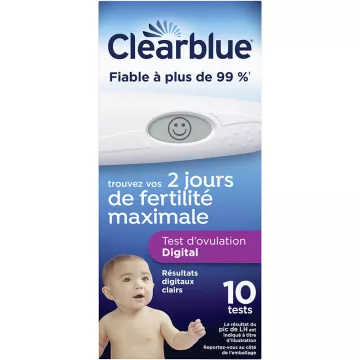
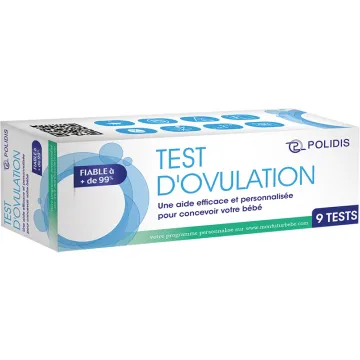
Would you like to better understand your cycle to maximize your chances of conceiving? At Soin-et-nature, we offer ovulation tests designed to accurately detect the surge in luteinizing hormone (LH), a key indicator that ovulation is imminent. Easy to use, reliable, and shipped quickly, these kits help you identify the most fertile period of your cycle. It’s a simple, natural, and reassuring way to guide you step by step through your journey to pregnancy.
More detailsAn ovulation test is a test that helps you detect when you’re ovulating—an important factor to know in order to maximize your chances of getting pregnant or when you’re trying to conceive. In each cycle, a woman is actually fertile only for a very short period: 3–4 days before ovulation and on the day of ovulation. Determining your ovulation period therefore helps you identify your fertile window and plan sexual intercourse at the right time.
Available over the counter at pharmacies and online, these tests come in the form of strips or sticks onto which a woman places a few drops of urine, preferably at the same time each day.
The test detects luteinizing hormone (LH), specifically the LH surge. This hormone is produced in greater quantities 24 to 36 hours before ovulation: from less than 10 IU/mL at the start of the cycle to nearly 70 IU/mL at the time of the ovulatory surge; it is this rise in LH that triggers ovulation.
It is not necessary to take an ovulation test every day of the cycle; doing so is unnecessary and would be costly. To determine when to start using the test, doctors recommend subtracting 16 to 18 days from the length of your cycle. For a 28-day cycle, you should begin testing on the 10th day (28–18), which is 10 days after the start of your period. If no ovulation has been detected after 10 days of testing, it’s advisable to start testing again in the next cycle, beginning two days earlier.
If cycles vary in length, it is best to use the shortest cycle as a guide and start testing earlier to avoid missing ovulation. If cycles are very long (more than 40 days), very short (less than 22 days), or irregular, it is recommended to use another method, such as a basal body temperature chart, to first verify that ovulation is actually occurring.
Check out our selection of ovulation tests. Effectively combat minor everyday discomforts with high-quality, effective remedies.
Have you decided to have a baby and want to know the best time to make your dream of getting pregnant come true? The ovulation test helps you maximize your chances of conceiving naturally by identifying your most fertile days during each cycle. It’s easy to use and detects, in just a few minutes, the surge inLH ( luteinizing hormone ), also known as the fertility hormone.
To maximize your chances of getting pregnant, it’s very helpful to know your ovulation period so you can identify your optimal fertility window. Among the various methods for detecting this key day of fertility, ovulation tests are considered the most reliable.
Materials and Types:
The tests generally come in two formats:
Steps for use:
Regular cycles:
For a 28-day cycle, testing generally begins on the 10th day. It is not necessary to test daily throughout the cycle, as this would be costly and unnecessary.
Irregular cycles:
Advantages:
Limitations:
Soin-et-Nature offers a complete range of products to support women in their journey to conceive and through the early stages of motherhood. Here are the main categories available:
These products for trying to conceive, available on Soin-et-Nature, allow you to experience this important milestone with peace of mind and well-being, while naturally supporting the health and comfort of the expectant mother.