When should Orthosamine for ages 3–18 be used to support vitality and growth?
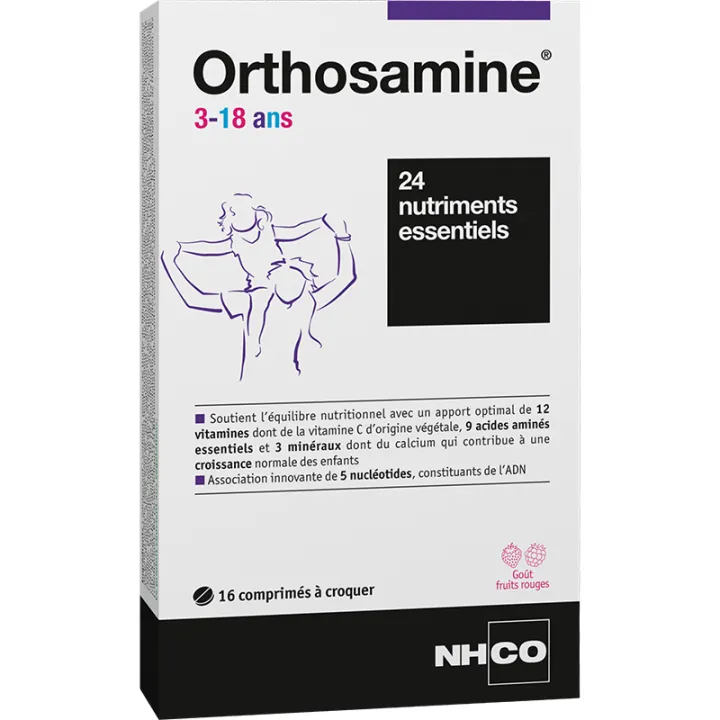
Between school lunches, quick snacks, and “I don’t like that,” it’s hard to ensure your child is getting all the essential nutrients they need. Yet, between the ages of 3 and 18, their body is working at full capacity: bone growth, brain development, and an immune system still in the works...That’s where NHCO Orthosamine for Ages 3–18 comes in—a formula designed to address potential nutritional gaps and support the body’s vitality.
This dietary supplement combines 24 essential nutrients: 12 vitamins, 9 essential amino acids (those the body cannot produce on its own), 3 minerals, and nucleotides. No frills—just what really matters to support normal growth and bone development with calcium, strengthen children’s immune systems with vitamin D, and support cognitive function with zinc and copper.
Why are young people’s nutritional needs so specific?
Imagine this: a 14-year-old teenager can sometimes grow as much as 10 cm in a single year. Their bones are lengthening, their muscles are developing, and their brain is restructuring. All of this requires an impressive amount of building materials. And unlike us adults, they can’t draw on reserves that don’t exist.
Nucleotides, for example, are the building blocks of DNA. When cells are multiplying at breakneck speed (which is the case in young people), the body needs these components to produce new genetic material. It’s like trying to build a house: without bricks, you’re stuck.
Vitamin D plays a major role that’s often underestimated. It doesn’t just help the body absorb calcium—it orchestrates the entire process of bone mineralization. Without it, even with plenty of calcium, bones remain fragile. It also plays an active role in the immune system—which explains why we get repeated colds in the winter when we’re deficient.
The B vitamins are the unsung heroes of energy production. Vitamins B1, B2, B3, B5, B6, and B8 convert food into fuel that cells can use. Vitamins B9 and B12 support normal physiological functions, particularly red blood cell production. Does your teen seem run-down in the evenings? These vitamins might be to blame.
Practical tip: This supplement obviously isn’t a substitute for a balanced diet, but it acts as a nutritional safety net. It’s especially helpful during growth spurts, when schoolwork is taking a toll, or if your child is a picky eater (we’re not judging—we’ve all been there).
How should you use this dietary supplement for growth?
Take it with a meal of your choice— breakfast, lunch, or dinner — one chewable tablet per day.
The tablet can be split in half if needed.
16-day program, repeatable for up to 3 months.
After 3 months of use, take a break of at least 1 month.
Share your feedback on the usage instructions and dosage for Orthosamine (ages 3–18) with our partner Avis Vérifiés after your purchase.
Precautions
- Suitable for vegans.
- Best consumed before the date indicated on the package.
- Store in a cool, dry place, away from light.
- Not recommended for people with thyroid conditions (due to the iodine content in lithothamnion).
- This dietary supplement is not a medication.
- Follow the recommended daily dose.
- Use as part of a varied and balanced diet and a healthy lifestyle.
- Keep out of reach of young children.
What are the ingredients in this dietary supplement for vitality and growth?
Sweetener: Sorbitol, Lithothamnion Thallus Powder (Lithothamnium Calcareum) including calcium, Acerola Berry Concentrate (Malpighia glabra), including Vitamin C, Red Beet Juice, Acidity Regulators (Tricalcium Phosphate, Citric Acid), Natural Flavor, Anti-Caking Agent: Magnesium Stearate, L-Leucine, Nucleotides (Disodium Salts of Cytidine, Guanosine, Inosine, Uridine, and Adenosine Monophosphates), Zinc Bisglycinate, L-Phenylalanine, L-Isoleucine, L-Valine, L-Threonine, L-Lysine Hydrochloride, Flavoring, Copper Bisglycinate, L-Histidine, L-Tryptophan, L-Methionine, Vitamins B3 (Nicotinamide), B5 (Calcium D-Pantothenate), E (D-Alpha-Tocopheryl Succinate), D3 (cholecalciferol), A (retinol acetate), B12 (cyanocobalamin), B6 (Pyridoxine Hydrochloride), B1 (Thiamine Hydrochloride), B2 (Riboflavin), B9 (Folic Acid), and B8 (Biotin); Sweeteners: Sucralose, Sodium Saccharin.
Nutritional Information Table:
| Nutrient |
Amount |
NRV* |
| Vit. A |
120 μg |
15% |
| Vitamin B1 |
0.33 mg |
30% |
| Vitamin B2 |
0.42 mg |
30% |
| Vitamin B3 |
8 mg |
50% |
| Vitamin B5 |
5 mg |
83% |
| Vitamin B6 |
0.42 mg |
30% |
| Vitamin B8 |
15 μg |
30% |
| Vitamin B9 |
100 μg |
50% |
| Vitamin B12 |
0.75 μg |
30% |
| Vitamin C |
40 mg |
50% |
| Vitamin D3 |
5 μg |
100% |
| Vitamin E |
3 mg |
25% |
| Calcium |
120 mg |
15% |
| Zinc |
3 mg |
30% |
| Copper |
0.3 mg |
30% |
*NRV: Nutrient Reference Values.
Packaging
Box of 16 chewable tablets, red berry flavor.
Our Expert Advice on Orthosamine for Ages 3–18 to Support Vitality
In pediatric micronutrition, there are three critical periods when nutritional needs surge: the start of the school year (September–October), the end of the first quarter when fatigue sets in (January–February), and growth spurts during puberty. If your child grows several centimeters in a few months or your teenager sleeps 12 hours a night, this is often a sign that their body needs support.
It’s best to give it in the morning at breakfast with a food containing a little fat—a slice of buttered bread, full-fat yogurt. Vitamins A, D, and E are fat-soluble: they need fat to be properly absorbed. Without it, you lose some of the supplement’s effectiveness.
Pair the supplement regimen with a “rainbow” plate . Each color of fruit or vegetable provides different phytonutrients that supplements cannot replace: broccoli for sulforaphane, carrots for carotenoids, and blueberries for anthocyanins. These molecules work synergistically with the vitamins in the supplement.
Hydration is often overlooked, yet a dehydrated child has trouble absorbing nutrients. Aim for at least 1 to 1.5 liters of water per day, and avoid commercial fruit juices, which cause blood sugar spikes that are counterproductive to concentration.
After a 3-week course, note any changes: improved sleep, fewer energy slumps at 5 p.m., and better recovery after sports. If there’s no improvement after 1 month, consult your doctor—sometimes an iron deficiency or a sleep disorder masks the real problem.
FAQ
At what age can Orthosamine 3–18 be used?
This supplement is formulated for children ages 3 and up and adolescents up to age 18.
Can it be used for several months?
Yes, it can be taken for up to 3 consecutive months, followed by a 1-month break.
Is it suitable for a child who eats few fruits and vegetables?
It can help supplement micronutrient intake while gradually encouraging a more varied diet.