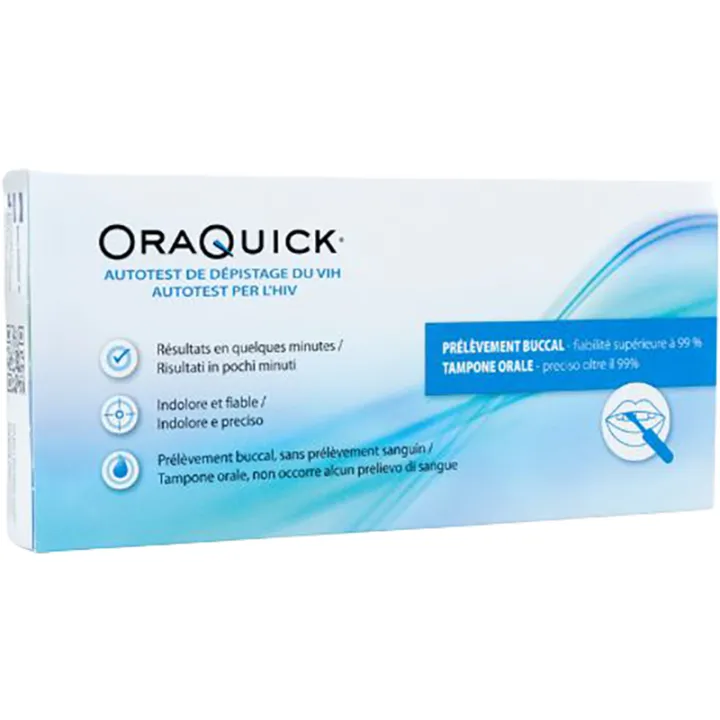
Get tested easily at home with Medisur's OraQuick HIV self-test. Fast and reliable results in 20 minutes. Available at pharmacies.
Medisur’s OraQuick non-invasive oral HIV self-test is a major breakthrough in the rapid and easy detection of HIV. This self-administered test detects antibodies to HIV-1 and HIV-2 using a buccal swab. Unlike other tests, it does not require blood, making it more accessible and less invasive. The buccal swab method uses oral mucosal transudate—a fluid rich in anti-HIV antibodies—ensuring accurate detection without the need to collect saliva.
The main advantage ofthe OraQuick HIV self-test is its speed and ease of use. In just 20 minutes, you can get a preliminary result, providing you with quick peace of mind if you have any doubts. Furthermore, its 98% ease-of-use rating demonstrates just how intuitive and easy this test is to perform, even for those with no medical experience.
It is important to note that HIV detection with this self-test may take up to 3 months after exposure. This means that if the test is performed too soon, it may not detect the virus and could yield a false-negative result. That is why it is recommended to retake the test after this period to confirm the initial result. If the result is positive, it is crucial to consult a doctor for additional testing and to obtain a definitive diagnosis.
The OraQuick test also stands out for its safety and hygiene. No biohazard container is required for disposing of the test after use, and there is no risk of HIV transmission through saliva. This makes it a safe and convenient choice for anyone who wants to test themselves at home, without the stress of having to visit a medical facility.
Finally, this self-test works through a 20-minute immunoassay with visual reading. The test strip contains synthetic peptides representing the HIV envelope region and a procedural control, thereby ensuring optimal accuracy. Results are clearly displayed in the test zone (T) and the control zone (C), allowing for easy and unambiguous reading.
In summary, Medisur’s OraQuick oral HIV self-test is a practical, fast, and reliable solution for detecting the presence of HIV. Its simple and non-invasive use makes it an ideal choice for those who wish to monitor their health discreetly and effectively. Thanks to this innovation, early HIV detection is now within reach, offering everyone the opportunity to take proactive steps for their health.
To usethe OraQuick HIV self-test, it is essential to follow certain precautions before the sample collection to ensure accurate results:
This test is not intended for people who are already HIV-positive, on antiretroviral therapy, or on pre-exposure prophylaxis. Following these instructions ensures optimal testing conditions for the reliable detection of HIV antibodies in oral mucosal fluid.
Share your feedback on the usage instructions and dosage of the OraQuick HIV self-test with our partner Verified Reviews after your purchase.
Precautions for Use
These precautions ensure that the test is performed under optimal conditions, thereby maximizing the reliability of the results.
TheOraQuick HIV self-test kit contains the following items:
Overview
The kit consists of a single test, allowing for simple and straightforward use at home.
Currently in France, 150,000 people are living with HIV, and 20% of those infected are unaware of their HIV-positive status.
What are HIV and AIDS?
The acronym HIV stands for “human immunodeficiency virus.” HIV is the virus that causes AIDS, or acquired immunodeficiency syndrome, if left untreated. When a person is infected with HIV, the virus first attacks the immune system, which is the body’s defense system against disease. That person then becomes more susceptible to illnesses and infections. When the body loses its ability to defend itself against disease, the person is diagnosed with AIDS. HIV infection is incurable. Antiretroviral drugs can slow or halt the progression of the disease.
Serological window
This is the period between HIV infection and the time when a test can reliably produce a positive result. A person may test positive using the INSTI® HIV self-test as early as 21 to 22 days after infection,¹ though it may take up to 3 months to produce a positive result.
A negative result may not be accurate until 3 months have passed since infection. If the user believes they have been exposed to HIV within the last 3 months and their results are negative, they will need to repeat the test at least 3 months after exposure.
How does a person become infected with HIV?
HIV is transmitted through bodily fluids (such as blood, semen, or vaginal secretions). The virus can, for example, be transmitted during unprotected sex or through the sharing of needles for injecting drugs. Women living with HIV can pass the virus on to their babies during pregnancy, childbirth, and breastfeeding. It is also possible—though rare today—to become infected with HIV through a blood transfusion.